
 LANGUAGE
 English
 Deutsch
 Español
 Français
 русский

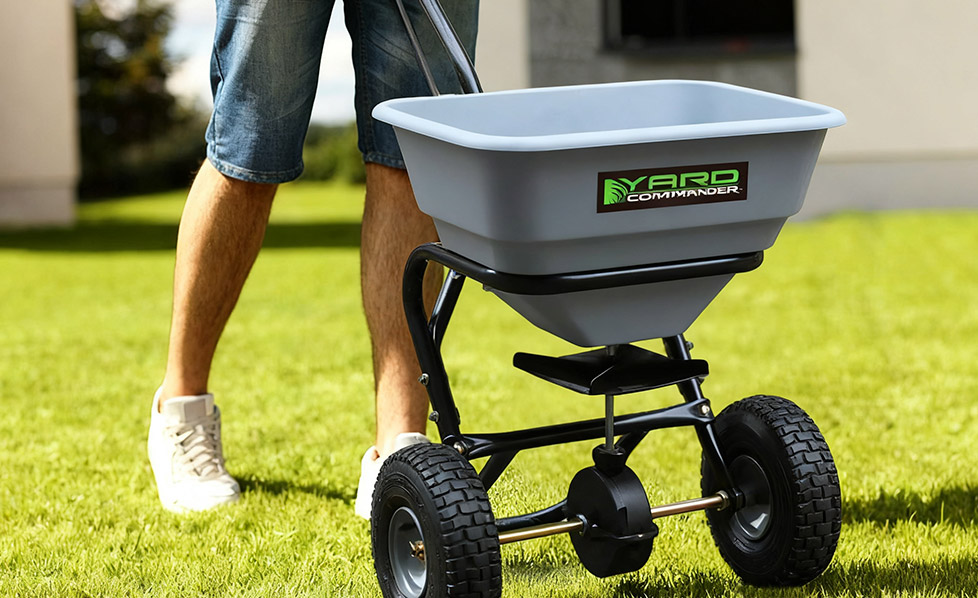










DESCRIPTION ♦Metal gear in side of the gear box ♦Accesso...
See Details
75 lb All-Purpose Push Spreader: Precision, Durability, and Efficient Lawn Care
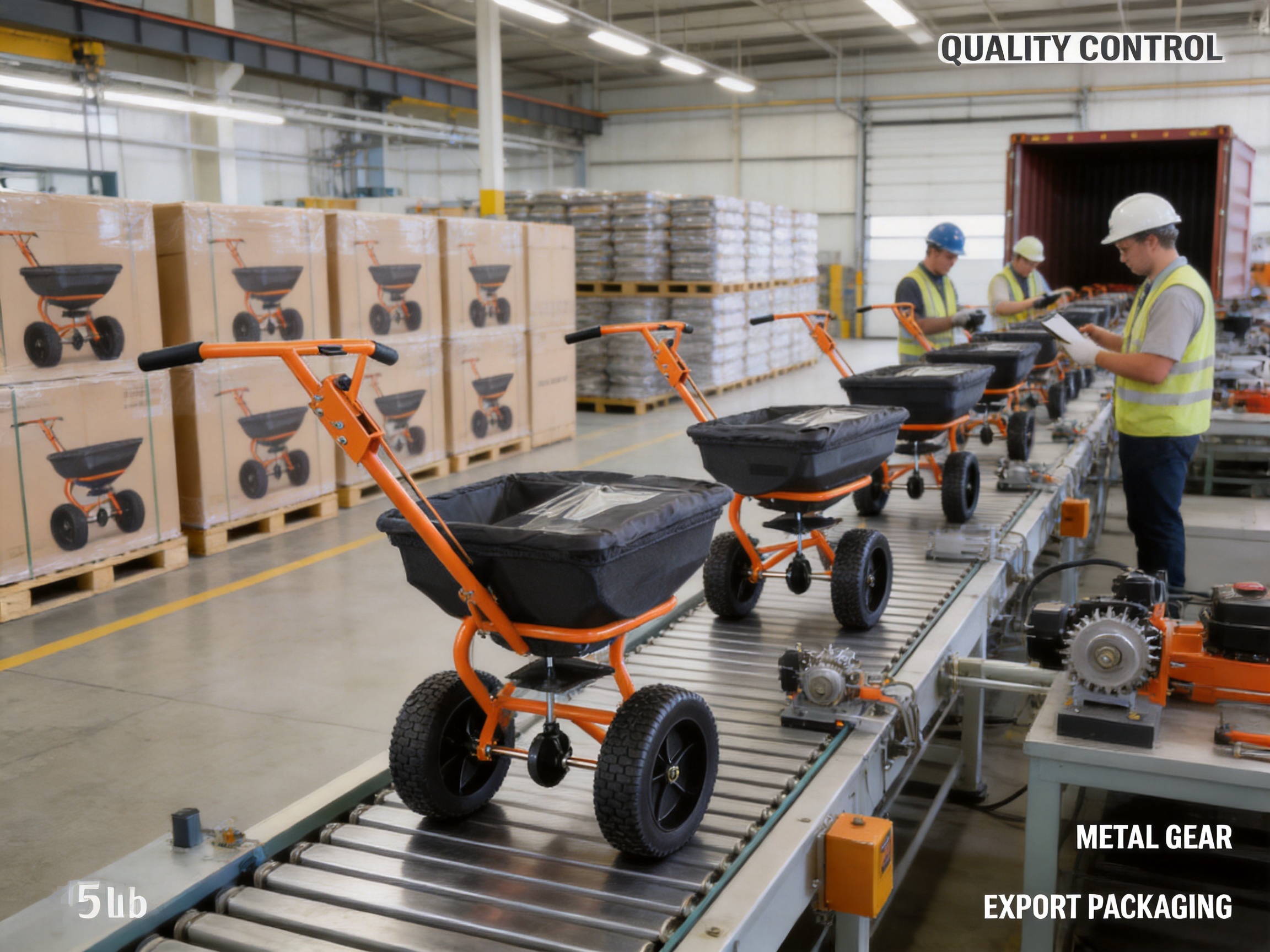
A dependable broadcast spreader is one of the most useful tools for maintaining lawns, gardens, sports fields, estates, and other outdoor spaces. Whether the material is fertilizer, grass seed, ice-melting compound, or another approved granular treatment, the quality of the spreader directly affects coverage, product consumption, labor efficiency, and the final appearance of the ground. The 75 lb. All-Purpose Spreader SP31571 is designed to provide a practical balance of capacity, control, durability, and maneuverability for users who require more than a basic lightweight spreader.
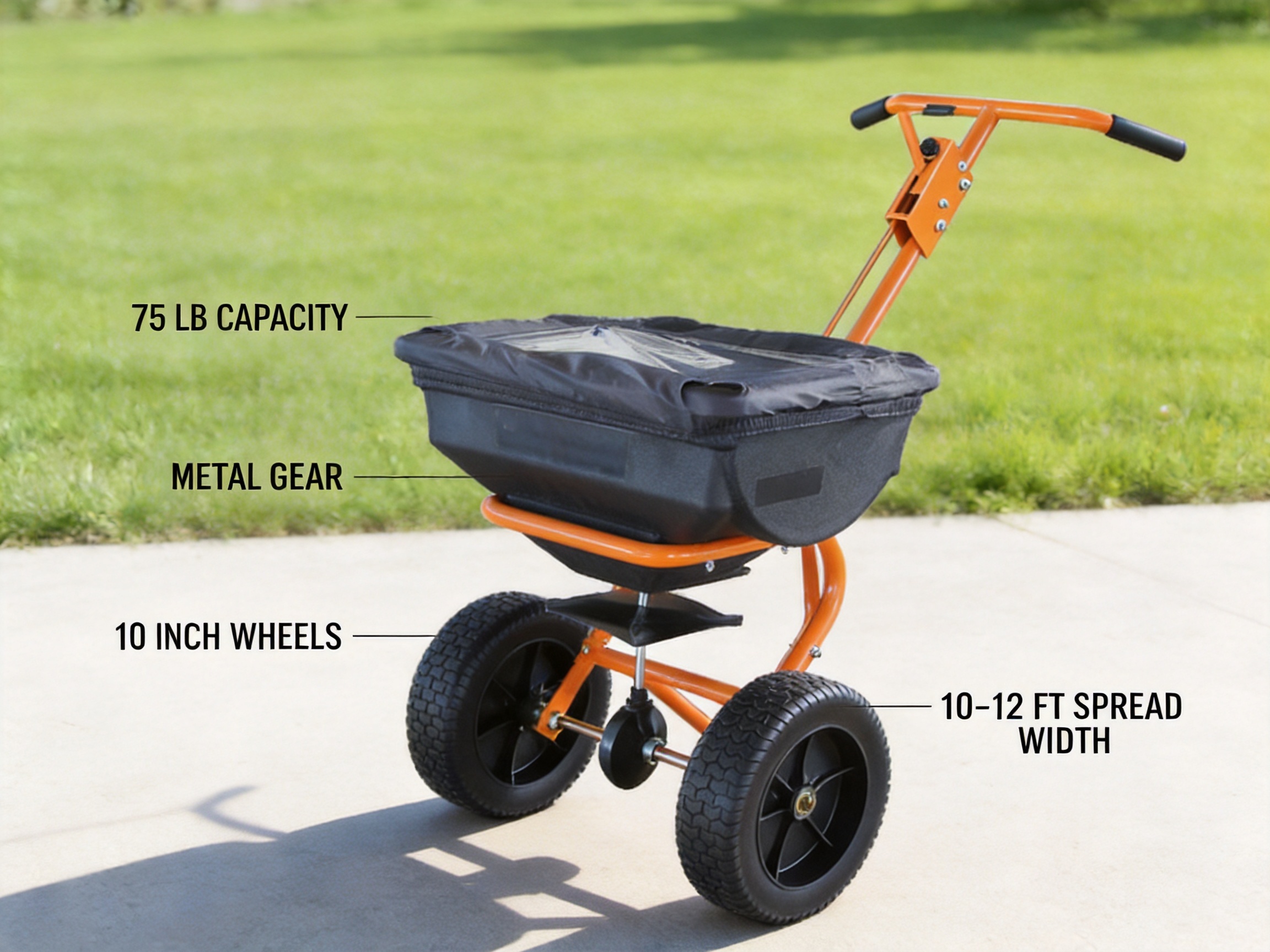
With a 75 lb capacity, a 10- to 12-foot spreading width, a metal gear system, a handle-mounted rate control, 10-inch tubeless wheels, and included screen and rain-cover accessories, this push spreader is built for consistent outdoor operation. Its design is suitable for homeowners with large properties, professional landscapers, groundskeeping teams, rental businesses, agricultural retailers, and distributors seeking a versatile lawn-care product.
The product is manufactured by Jiashan Superpower Tools Co., Ltd., a Chinese producer of log splitters and lawn and garden equipment with more than two decades of industry experience. The company operates an ISO 9001:2015-certified quality management system and manufactures products for customers in North America, Europe, Australia, Asia, and South America. These capabilities support a product-development approach that combines practical use, controlled manufacturing, export readiness, and cost-conscious engineering.
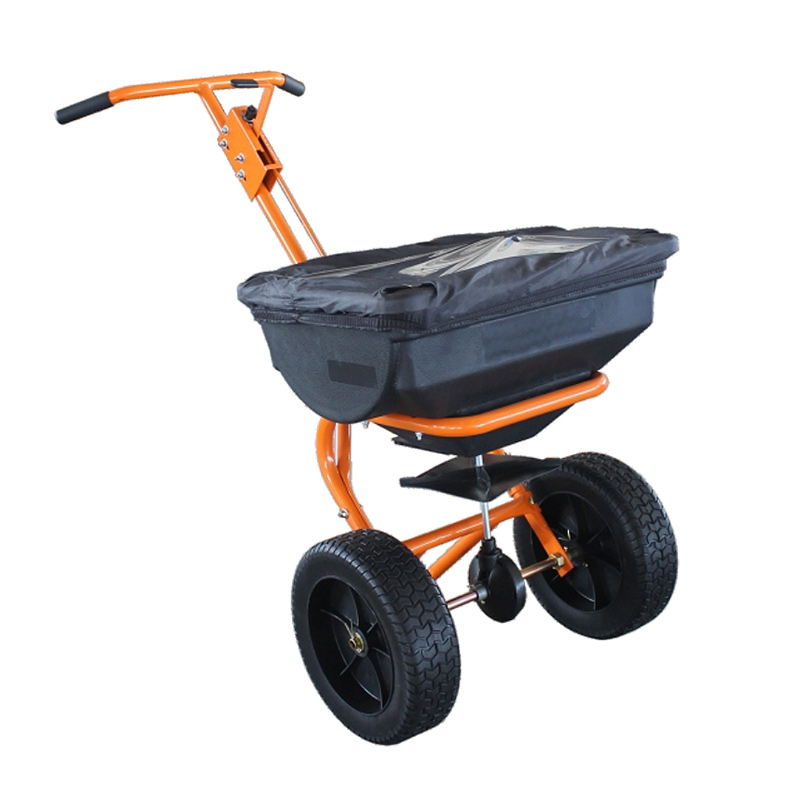
75lb. All Purpose Spreader SP31571
Understanding the Purpose of a 75 lb Push Spreader
A push spreader distributes granular material through a rotating broadcast mechanism as the operator walks behind the unit. The hopper stores the material, the metering system controls the release rate, and the wheels provide the mechanical movement needed to drive the spreading mechanism. Compared with hand-held spreaders, a push spreader can cover larger areas with less physical strain and more consistent walking patterns.
The SP31571 is categorized as a push spreader and is intended for users who want an uncomplicated, manually operated solution. It does not depend on fuel, batteries, or an electrical motor. This makes it easy to start, quiet during use, relatively simple to maintain, and suitable for locations where engine-powered equipment would be excessive or impractical.
A 75 lb hopper capacity is particularly useful because it reduces the number of refills required during routine work. The actual amount of material that can be loaded depends on its density and particle size, but the rated capacity gives the user a substantial working volume compared with smaller residential spreaders. Fewer stops for refilling can improve productivity when treating lawns, walkways, private roads, commercial grounds, or large landscaped areas.
The spreader’s 10- to 12-foot working width also contributes to efficient coverage. A wider pattern means that the operator can treat more ground during each pass, reducing the total number of walking lanes needed. Correct overlap remains important, but the broad pattern helps shorten operating time when compared with narrow hand-operated equipment.
Core Product Specifications
The following specifications summarize the principal features and operating dimensions of the SP31571.
Specification | Product Detail |
Product | 75 lb. All-Purpose Spreader |
Model | SP31571 |
Category | Push Spreader |
Capacity | 75 lb |
Spread Width | 10–12 feet, approximately 3045–3658 mm |
Wheels | 10-inch tubeless wheels |
Gear System | Metal gear |
Rate Control | Handle-mounted adjustment control |
Accessories | Screen and rain cover |
Net Weight | 23.6 lb, approximately 10.7 kg |
Gross Weight | 26.4 lb, approximately 12 kg |
Packaging Size | Approximately 63 × 39 × 39 cm |
Container Loading Quantity | 340 pieces per 40-foot high-cube container |
Figure Number | BS0702 |
The combination of these specifications gives the machine a practical profile for both individual users and commercial distribution. The spreader is large enough to reduce repeated refilling while remaining light enough to be pushed manually. Its packaging dimensions and container quantity are also relevant to wholesalers, importers, garden-equipment retailers, and project buyers planning inventory shipments.
Metal Gear Construction for Greater Durability
One of the most important distinctions of the SP31571 is its metal gear inside the gearbox. The gearbox transfers wheel movement to the spreading mechanism, so the gear is exposed to repeated motion whenever the unit is pushed. A gear made from metal is intended to provide stronger resistance to wear than a comparable basic plastic gear, particularly when the spreader is used regularly or operated over uneven ground.
Gear durability matters because the spreading mechanism must rotate consistently for the broadcast pattern to remain predictable. If the gear system wears prematurely, becomes damaged, or loses engagement, the operator may experience irregular material flow, reduced coverage, or complete loss of spreading action. A robust metal gear helps support dependable mechanical transmission during normal use.
The metal gear also contributes to the product’s appeal in professional and commercial environments. Landscapers and grounds crews may use a spreader repeatedly across a season, while rental companies need products that can tolerate operation by different users. Retailers and distributors likewise benefit from offering equipment with a visible durability advantage over entry-level models that rely entirely on lightweight plastic drive components.
Metal construction does not eliminate the need for proper care. Users should still avoid forcing the spreader through obstructions, overloading the hopper, operating it with damaged wheels, or storing it with wet fertilizer inside. However, the metal gear provides an important foundation for long-term service when the product is used according to its intended purpose.
Why Gear Material Matters in Competitive Comparison
Many low-cost spreaders are designed primarily around minimum purchase price. Such products may be acceptable for occasional light-duty work, but their drive components can be a limitation when they are exposed to frequent use, heavy loads, or rough handling. The SP31571 competes more effectively in this area by emphasizing a metal gear inside the gearbox.
For buyers comparing similar spreaders, gear material should be considered together with capacity, wheel construction, adjustment design, replacement-part support, and the intended duty cycle. A metal gear alone does not determine overall quality, but it is a meaningful component-level advantage because it directly supports the mechanical system responsible for broadcasting material.
Handle-Mounted Rate Control
Accurate application depends on more than hopper capacity. The spreader must release the appropriate amount of material for the job. The SP31571 includes a rate-setting control on the handle, allowing the operator to make adjustments without repeatedly stopping to reach down to the hopper or interrupting the walking process.
A handle-mounted control improves convenience and can make operation more intuitive. Before beginning, the user can select an appropriate opening according to the material and application instructions. During operation, the control can be adjusted if the material flows too slowly or too quickly, provided that changes are made carefully and consistently.
This feature is especially useful when moving between different areas. A lawn may require one setting, while a walkway, garden border, or larger open area may require another. The ability to access the adjustment from the handle gives the operator greater control over the work process and reduces unnecessary bending.
Rate control is also important for responsible material use. Applying too much fertilizer can damage turf and increase costs. Applying too little may produce uneven growth or fail to achieve the desired treatment. A clearly accessible adjustment mechanism helps the user work toward a more controlled application rate, although the correct setting should always be confirmed with the material manufacturer’s instructions.
Practical Application Technique
For the most uniform results, the operator should first inspect the spreader, confirm that the metering system moves correctly, and choose a walking speed that can be maintained across the entire job. The spreader should generally be started and stopped according to the material instructions so that concentrated piles are not created at the beginning or end of a pass.
Walking in straight, parallel lines helps maintain a consistent pattern. Slight overlap between adjacent passes may be necessary depending on the material and the distribution pattern. Sudden changes in speed can alter the amount of material applied over a given distance, so a steady pace is preferable.
The rate control should be adjusted gradually rather than opened fully without testing. For unfamiliar material, a small test area can help the operator assess the pattern and application rate before treating the entire lawn. This approach reduces waste and lowers the possibility of overapplication.
Comfortable T-Handle Design
The SP31571 is equipped with a T-shaped handle intended to provide a comfortable and stable hand position. A properly shaped handle can reduce strain during extended pushing and provide improved control when turning, starting, or stopping the spreader.
Handle comfort becomes increasingly important as the hopper approaches its rated capacity. A fully loaded spreader is substantially heavier than an empty one, and the operator must control both forward movement and directional changes. A T-handle gives the user a broad gripping area and supports a balanced pushing posture.
The handle also places the rate-setting control in a convenient operating area. This creates a more integrated user interface: the operator holds the spreader, controls the direction, and adjusts the output from the same general position. Such practical details can have a considerable effect on the experience of using the machine over a large property.
Although the spreader is manually pushed, the design is not limited to small residential lawns. Its capacity and working width make it suitable for broader maintenance tasks, while the handle configuration supports the repeated movements associated with professional grounds care.
10-Inch Tubeless Wheels for Maneuverability
The SP31571 uses 10-inch tubeless wheels. Wheel diameter affects how easily a spreader rolls over grass, compacted soil, pavement, and minor surface irregularities. Larger wheels generally help the equipment move more smoothly than very small wheels, particularly when the hopper is carrying a substantial load.
Tubeless construction removes the need for an inner tube and can simplify ownership by reducing the risk of tube pinch, tube replacement, and certain maintenance problems associated with pneumatic tube systems. The wheel design is well suited to a manually pushed lawn-care tool where straightforward service and reliable movement are important.
Good wheel performance also helps preserve a more even spreading pattern. If a wheel repeatedly catches, slips, or sinks, the operator’s walking speed may change and the broadcast mechanism may not rotate uniformly. Smooth rolling supports consistent forward motion and makes it easier for the user to follow straight passes.
When operating on sloped or uneven ground, the user should push at a controlled speed and avoid sudden turns. The spreader should not be overloaded beyond its rated capacity, and the wheels should be inspected periodically for damage, obstruction, or abnormal wear. These basic practices help protect both maneuverability and the drive system.
10- to 12-Foot Spread Width
The specified spreading width is approximately 10 to 12 feet, or about 3045 to 3658 millimeters. This range gives the SP31571 a useful balance between coverage and controllability. A narrow spreader may require many passes across a large lawn, while an excessively wide pattern can be difficult to manage near gardens, flower beds, driveways, and property boundaries.
The effective width can vary according to the material, particle size, moisture content, application setting, walking speed, and environmental conditions. For this reason, the stated width should be understood as a practical operating range rather than an identical result for every substance.
For open lawns and broad areas, the width can reduce the number of passes needed. For confined areas, the operator can adjust the walking route and rate control to keep material away from sensitive locations. Careful planning is particularly important around ponds, drainage channels, ornamental beds, sidewalks, and areas where material should not be applied.
The broad pattern is one of the main ways the product compares favorably with small hand spreaders. The user can cover a much greater area per pass while maintaining a familiar push-operated format. This helps make the spreader suitable for properties where a hand-held tool would be slow and physically tiring but a powered broadcast machine would be unnecessary.
Screen and Rain Cover Accessories
The SP31571 is supplied with a screen and rain cover. These accessories add practical value to the basic spreader and support more controlled use in changing outdoor conditions.
A screen can help filter or manage material as it enters the hopper. Depending on the material, a screen may help limit the passage of larger clumps or foreign particles that could interfere with the metering mechanism. It can also support smoother handling of granular products that have been stored in less-than-ideal conditions.
The rain cover helps protect the hopper contents from light exposure to rain or moisture during operation. Moisture can cause some fertilizers, seeds, and treatment products to clump, which may result in inconsistent flow or blockages. The cover is therefore a useful convenience when weather conditions change unexpectedly.
The cover should not be interpreted as permission to operate the spreader in severe weather or to leave wet material inside the hopper. After use, the spreader should be emptied and cleaned according to the material manufacturer’s safety instructions. Keeping the hopper dry and free from residue is one of the simplest ways to support reliable future operation.
Versatile Outdoor Applications
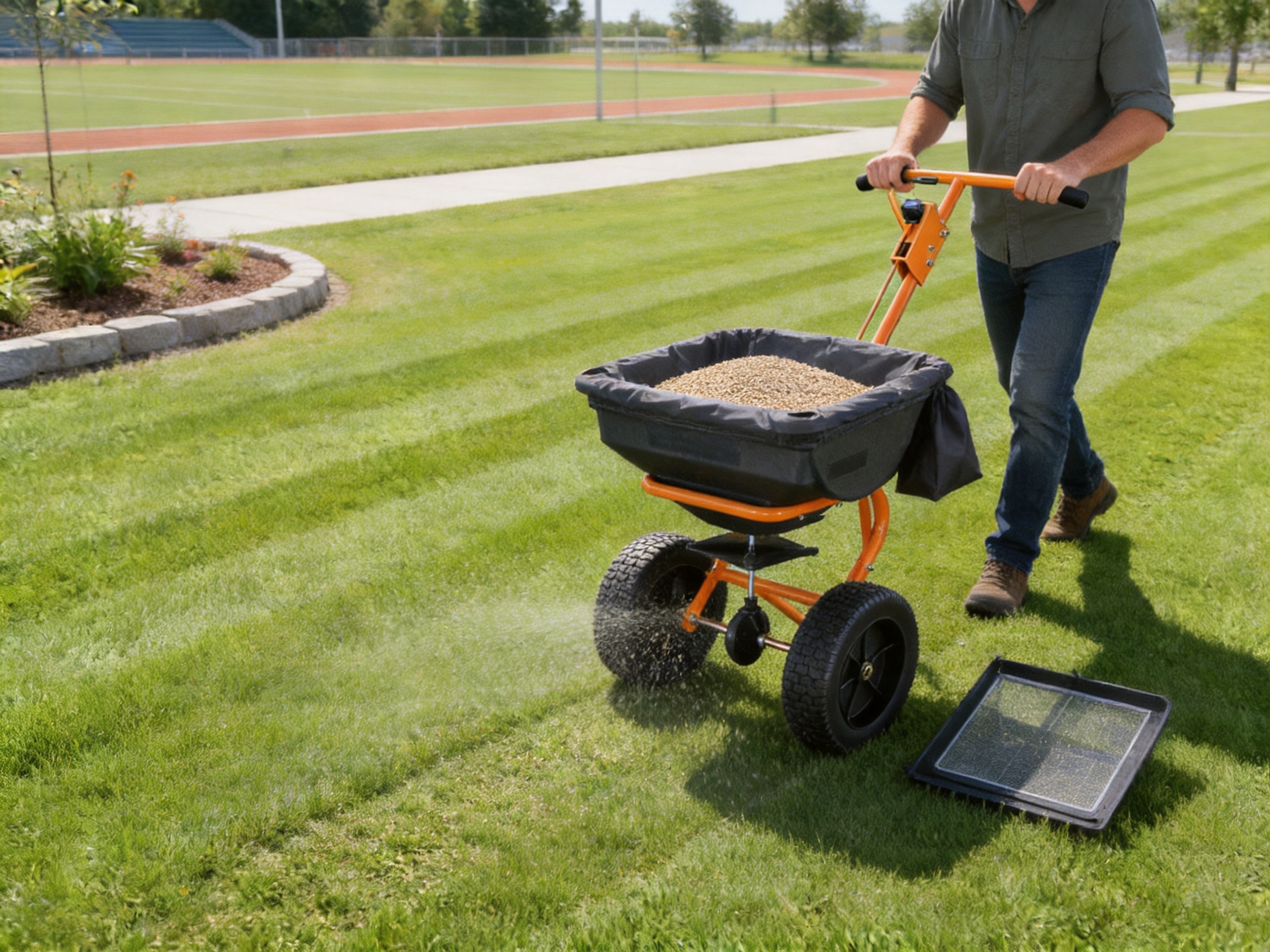
The term “all-purpose” reflects the spreader’s broad utility with compatible granular materials. Common applications may include lawn fertilizer, grass seed, soil amendments, granular weed-control products approved for broadcast use, and ice-melting products designed for spreader application. Users must always verify compatibility, dosage, and safety requirements before loading any material.
For residential users, the spreader can support seasonal lawn preparation, routine feeding, overseeding, and winter walkway maintenance. Its 75 lb capacity is useful for larger yards where a small hand spreader would require repeated refills.
For landscaping contractors, the machine can serve as a portable tool for properties of different sizes. Its manual operation avoids the need to transport fuel or charge batteries, and its comparatively straightforward design can be explained quickly to new workers.
For municipalities, schools, sports facilities, and commercial property managers, the spreader can be used for routine grounds maintenance when a compact, low-noise, manually controlled tool is preferred. It may also be useful for maintenance teams that need several identical units for different work areas.
Garden centers, agricultural suppliers, hardware stores, and outdoor-equipment retailers may find the product attractive because its application range is easy for customers to understand. The combination of recognizable functions, substantial capacity, and included accessories creates a product profile that can be positioned above basic entry-level models.
Recommended Material Considerations
Materials differ in density, granule size, moisture sensitivity, and flow behavior. Fertilizer may flow differently from grass seed, and salt-based products may have different storage and corrosion considerations. The correct rate control setting for one product should not automatically be transferred to another.
Operators should read the application instructions supplied with the material and conduct a controlled test where appropriate. The hopper should be filled only to a level that remains manageable for the operator and within the product’s rated capacity. Material should not be left in the spreader after use, particularly when it may attract moisture or cause corrosion.
When using products that require protective equipment, restricted application areas, or special disposal practices, the user must follow the relevant label and local regulations. The spreader is a mechanical application tool; it does not replace the safety instructions associated with the material being distributed.
Advantages Compared with Basic Competing Spreaders
Several features give the SP31571 a strong position when compared with smaller or more basic push spreaders.
Comparison Area | SP31571 Advantage | Practical Benefit |
Capacity | 75 lb rated capacity | Fewer refills and improved productivity on larger areas |
Drive System | Metal gear inside the gearbox | Greater resistance to wear in regular use |
Application Control | Handle-mounted rate adjustment | Convenient control and more consistent material management |
Working Width | Approximately 10–12 feet | More ground covered per pass |
Wheels | 10-inch tubeless design | Stable rolling and simpler wheel maintenance |
User Comfort | T-handle configuration | Improved grip during extended pushing |
Weather and Material Management | Screen and rain cover included | Better support for controlled loading and changing conditions |
Commercial Suitability | Professional capacity and export packaging | Suitable for distributors, contractors, and grounds teams |
These advantages are most meaningful when considered together. A high-capacity hopper without a durable drive system would be less valuable. A strong gearbox without convenient rate control would be harder to use. Wide coverage without stable wheels could produce inconsistent results. The design of the SP31571 brings these features into one manually operated platform.
The product also occupies a useful middle ground in the market. It provides more capacity and component durability than a small household spreader while avoiding the cost, noise, fuel requirements, and maintenance complexity of a motorized machine. This balance can appeal to buyers who want stronger performance without moving to powered equipment.
Manufacturing Experience and Product Development Strengths
Jiashan Superpower Tools Co., Ltd. specializes in log splitters and lawn and garden equipment, including dump carts, spreaders, lawn sweepers, lawn aerators, and other outdoor power equipment. Established in 1997, the company has developed more than two decades of manufacturing experience in a product sector that demands practical mechanical design, repeatable assembly, and durability in outdoor conditions.
Experience across several related equipment categories can support useful engineering knowledge. Products such as spreaders, carts, sweepers, and splitters all require attention to frames, wheels, drive systems, operator interfaces, load handling, packaging, and field service. This broader product background helps a manufacturer understand how outdoor equipment is transported, assembled, operated, stored, and maintained.
The company’s facility is located in the Huimin Economic Development Zone in Jiashan County, Zhejiang Province, between Shanghai and Hangzhou. This location provides access to established manufacturing resources, transportation infrastructure, component suppliers, and export channels. For international customers, an established industrial location can support more coordinated sourcing, production planning, inspection, and shipment preparation.
ISO 9001:2015 Quality Management
The company operates under an ISO 9001:2015-certified quality management system. ISO 9001 is associated with structured quality processes, documented procedures, customer-focused management, corrective action, and continual improvement. Certification does not mean that every product is free from possible defects, but it indicates that the organization has implemented a formal framework for managing quality-related activities.
For a product such as a push spreader, a quality-management system can support consistency in several areas. These may include incoming component checks, assembly procedures, inspection records, production traceability, handling of nonconforming products, and review of customer feedback. Consistency is particularly important when a product is manufactured in volume for multiple markets.
Repeatability matters to distributors and professional users. Buyers want units of the same model to have similar controls, dimensions, wheel behavior, and operating characteristics. A structured production system can help reduce variation and support more predictable purchasing decisions.
CE Certification and International Market Readiness
Many of the company’s products carry CE certification. Where applicable to the product and destination market, CE-related conformity supports access to European Economic Area markets and demonstrates attention to relevant product requirements. Specific conformity documentation should always be confirmed for the exact model and configuration being purchased.
International manufacturing also requires more than making the product itself. Packaging, labeling, documentation, container loading, export coordination, and communication with overseas customers are all important. The stated loading quantity of 340 pieces per 40-foot high-cube container gives commercial buyers a useful planning reference for procurement and logistics.
The combination of established manufacturing experience, quality-system operation, international market exposure, and product-specific engineering makes the company a capable source for buyers seeking private-label, wholesale, or long-term supply arrangements.
Production and Quality Considerations
The performance of a spreader is influenced by the quality of its assembled relationships: hopper support, gearbox alignment, wheel attachment, rate-control movement, handle stability, and broadcast components must work together. A manufacturer with experience in mechanical outdoor equipment can focus on these interfaces during product development and production.
Quality control should begin with suitable component selection. Metal gears, wheel assemblies, fasteners, handle parts, and hopper materials need to meet the product’s intended load and operating requirements. Components should then be assembled according to controlled procedures so that the drive system engages properly and the adjustment mechanism operates smoothly.
Inspection can include visual checks, dimensional verification, movement testing, packaging review, and functional evaluation of representative units. The exact inspection plan depends on the manufacturer’s internal procedures and customer requirements, but a structured approach helps identify problems before products are shipped.
Packaging is also important for a product with moving parts. The spreader must be protected against impact, abrasion, moisture, and shifting during transport. Its stated package size of approximately 63 × 39 × 39 centimeters provides a compact shipping profile that can help distributors plan warehouse storage and container utilization.
Efficient packaging should not compromise the protection of the gearbox, wheels, handle, or control components. A well-prepared package can reduce the likelihood of transit damage and help the retailer or end user receive a product in suitable condition for assembly and operation.
Storage, Maintenance, and Service Life
Correct maintenance can extend the useful service life of any spreader. After each use, the hopper should be emptied. Remaining fertilizer, salt, or other granular material can absorb moisture, harden, corrode components, or obstruct the metering system.
The unit should be cleaned according to the material’s safety requirements. Dry brushing may be appropriate for some residues, while other materials may require carefully controlled washing. If water is used, the spreader should be thoroughly dried before storage. Users should avoid directing water into areas where it may remain trapped around gears, bearings, or fasteners.
The metal gear and gearbox should be checked periodically for abnormal noise, looseness, or signs of damage. The wheels should be inspected for cracks, deformation, obstruction, or poor rolling. The handle and rate control should also be checked to confirm that they remain secure and responsive.
Storage in a dry, covered location is recommended. Extended exposure to rain, direct sunlight, standing water, or corrosive materials can shorten the life of the product. The rain cover is helpful during use, but it should not replace proper indoor or protected storage.
If the spreader is used with corrosive products such as certain de-icing materials, cleaning and drying become especially important. The operator should follow the product label and the equipment manufacturer’s maintenance guidance. Preventive care is generally less costly than repairing a neglected drive system or replacing a damaged hopper.
Safety and Responsible Operation
Before operating the spreader, the user should read the instructions for both the spreader and the material being applied. Appropriate protective clothing, gloves, eye protection, and respiratory protection should be used when required by the material label.
The operator should inspect the area for people, animals, water features, sensitive plants, vehicles, and objects that should not receive the material. Application should be avoided in conditions where wind may carry granules beyond the intended area. The spreader should be pushed at a controlled and consistent pace.
The product should never be overloaded beyond its rated 75 lb capacity. Excessive loading can make the spreader difficult to control and may place unnecessary stress on the wheels, handle, frame, and gearbox. The operator should use safe lifting techniques when adding material and should ask for assistance if a full load cannot be handled comfortably.
Care should be taken on slopes, wet grass, loose soil, and uneven surfaces. Turning sharply while the hopper is full may affect stability and can place additional stress on the wheel assemblies. The operator should maintain a secure grip on the T-handle and keep hands away from moving broadcast components.
After completing the task, the spreader should be emptied, cleaned, inspected, and stored safely away from children and unauthorized users. Any unused material should be handled according to its label and local disposal requirements.
Value for Distributors and Commercial Buyers
The SP31571 has characteristics that can support several business models. A distributor can offer it as a mid-capacity lawn-care product for homeowners and professional users. A landscaping company can purchase multiple units for seasonal treatment work. A rental business can include it in a fleet of manually operated grounds-maintenance equipment.
The product’s 75 lb capacity gives it a clear sales message. Customers can readily understand the advantage of having a larger hopper than a small residential spreader. The metal gear, tubeless wheels, handle rate control, and included accessories provide additional points of differentiation for product listings, retail displays, and sales discussions.
The shipping information is also useful for procurement planning. With a listed loading quantity of 340 pieces per 40-foot high-cube container, buyers can estimate inventory volume, freight allocation, warehouse requirements, and expected order quantities. Actual loading results may vary depending on packaging configuration and shipping conditions, so commercial buyers should confirm final logistics details before placing an order.
Because the manufacturer produces several categories of lawn and outdoor equipment, buyers may also consider developing a broader product range. A supplier relationship involving spreaders, dump carts, lawn sweepers, aerators, and related products can simplify sourcing and create opportunities for coordinated packaging, marketing, and after-sales support.
How the Spreader Supports Efficient Lawn-Care Work
Efficiency is not simply a matter of walking faster. It involves reducing unnecessary refills, maintaining a steady application pattern, controlling the amount of material used, and minimizing equipment downtime. The SP31571 supports these objectives through its relatively large capacity, broad working width, handle-mounted control, and durable mechanical drive.
For a large lawn, the operator can plan parallel passes that take advantage of the 10- to 12-foot broadcast range. The hopper capacity reduces interruptions, while the 10-inch wheels help maintain forward movement across ordinary lawn surfaces. The T-handle provides a stable position for controlling direction and speed.
For repeated professional work, the metal gear is especially relevant. A spreader that remains mechanically dependable can help reduce interruptions caused by drive-system failures. The operator still needs to clean and inspect the machine, but durable components can contribute to lower long-term operating inconvenience.
For homeowners, convenience may be the most important benefit. The spreader is manually operated, does not require fuel or charging, and can be prepared for use without a complicated startup procedure. The user can load the appropriate material, set the rate, and begin walking through the planned treatment area.
Q&A: Common Questions About the SP31571
What is the rated capacity of the spreader?
The rated capacity is 75 lb. The actual volume of material depends on density and particle size, so users should not assume that every material will fill the hopper to the same level or produce the same total coverage.
How wide is the spreading pattern?
The stated spread width is approximately 10 to 12 feet, equivalent to about 3045 to 3658 millimeters. Actual results may vary with material type, rate setting, walking speed, and weather conditions.
Does the spreader use a metal gear?
Yes. The SP31571 includes a metal gear inside the gearbox. This design is intended to provide improved durability and wear resistance compared with basic drive systems that rely entirely on lightweight plastic gearing.
Where is the rate control located?
The rate-setting control is located on the handle. This allows the operator to make convenient adjustments while remaining in the normal operating position.
What type of wheels does it have?
The spreader uses 10-inch tubeless wheels. They are designed to support stable manual movement and avoid the need for a separate inner tube.
What accessories are included?
The listed accessories include a screen and a rain cover. The screen can help manage material entering the hopper, while the rain cover helps protect the contents during light changes in weather.
Can it be used for fertilizer and grass seed?
It is designed as an all-purpose spreader for compatible granular materials, which may include fertilizer and grass seed. The user must confirm that the selected material is suitable for broadcast spreading and follow the material manufacturer’s application instructions.
Is it suitable for professional landscaping?
Its 75 lb capacity, broad spread width, metal gear, tubeless wheels, and adjustable control make it suitable for many professional landscaping and grounds-maintenance tasks. The appropriate choice depends on the required duty cycle, terrain, material, and local operating conditions.
Does it require fuel or a battery?
No. It is a manually pushed spreader and does not require an engine, fuel, or battery for normal operation.
How should it be cleaned after use?
The spreader should be emptied and cleaned according to the safety instructions for the material used. It should be dried thoroughly before storage, and residue should not be allowed to remain in the hopper or metering system.
Is the rain cover intended for long-term outdoor storage?
The rain cover is an operating accessory for protecting the hopper contents from light moisture. The spreader should still be stored in a dry, covered location when not in use.
What is the net weight?
The listed net weight is 23.6 lb, approximately 10.7 kilograms. The gross packaged weight is listed as 26.4 lb, approximately 12 kilograms.
Who manufactures this product?
The SP31571 is manufactured by Jiashan Superpower Tools Co., Ltd., a Chinese producer of log splitters, spreaders, lawn sweepers, dump carts, lawn aerators, and other outdoor power equipment.
What quality credentials are associated with the manufacturer?
The manufacturer operates an ISO 9001:2015-certified quality management system, and many of its products carry CE certification. Buyers should confirm the exact certification and conformity documents applicable to the specific model and destination market.
Conclusion
The 75 lb. All-Purpose Spreader SP31571 is a practical, durable, and versatile solution for distributing compatible granular materials across lawns, landscaped areas, grounds, and other outdoor spaces. Its most important strengths include a substantial 75 lb capacity, a 10- to 12-foot spread width, a metal gearbox gear, handle-mounted rate control, a comfortable T-handle, 10-inch tubeless wheels, and included screen and rain-cover accessories.
These features allow the product to compete effectively with smaller and more basic spreaders. It offers greater working capacity without requiring an engine or battery, while the metal gear provides a meaningful durability advantage for regular use. The convenient control layout and stable wheel design further support consistent operation.
The product is also supported by a manufacturer with a long operating history in outdoor equipment, an ISO 9001:2015-certified quality management system, international market experience, and a broad range of related products. Its manufacturing location, export capability, and listed container quantity make it relevant not only to individual users but also to wholesalers, retailers, contractors, rental businesses, and institutional buyers.
With proper material selection, responsible application, routine cleaning, and suitable storage, the SP31571 can provide an efficient and dependable approach to lawn and grounds maintenance. It is a strong choice for users who want the simplicity of manual operation together with the capacity and component durability associated with more substantial professional equipment.
References
1. Jiashan Superpower Tools Co., Ltd., SP31571 Product Information and Technical Specification Sheet.
2. ISO, ISO 9001:2015 Quality Management Systems—Requirements.
3. European Commission, General Principles of Product Conformity and CE Marking.
4. Turfgrass and Lawn-Care Equipment Operating Practices, general guidance for granular material application.
5. Manufacturer-provided information concerning outdoor power equipment production, product categories, packaging, and international distribution.
Product: 75lb. All Purpose Spreader SP31571
PREV:35-Ton Hydraulic Log Splitter for Efficient Firewood Processing
NEXT:37-Ton Vertical and Horizontal Log Splitter for Efficient Firewood Processing
NEXT:37-Ton Vertical and Horizontal Log Splitter for Efficient Firewood Processing
Interested in cooperation or have questions?
Related products
-
-
● Metal gear in side of the gear box ● Accessories: screen & rain ...
See Details -
DESCRIPTION ♦Metal gear in side of the gear box ♦Accesso...
See Details -
-
-
● Rust resistant powder coat finish ● Accessories: screen &rain co...
See Details
