 LANGUAGE
 English
 Deutsch
 Español
 Français
 русский











DESCRIPTION ♦Rust resistant powder coat finish ♦Accessor...
See Details
80 lb Push Spreader: Precision, Durability, and Efficient Lawn Care Performance
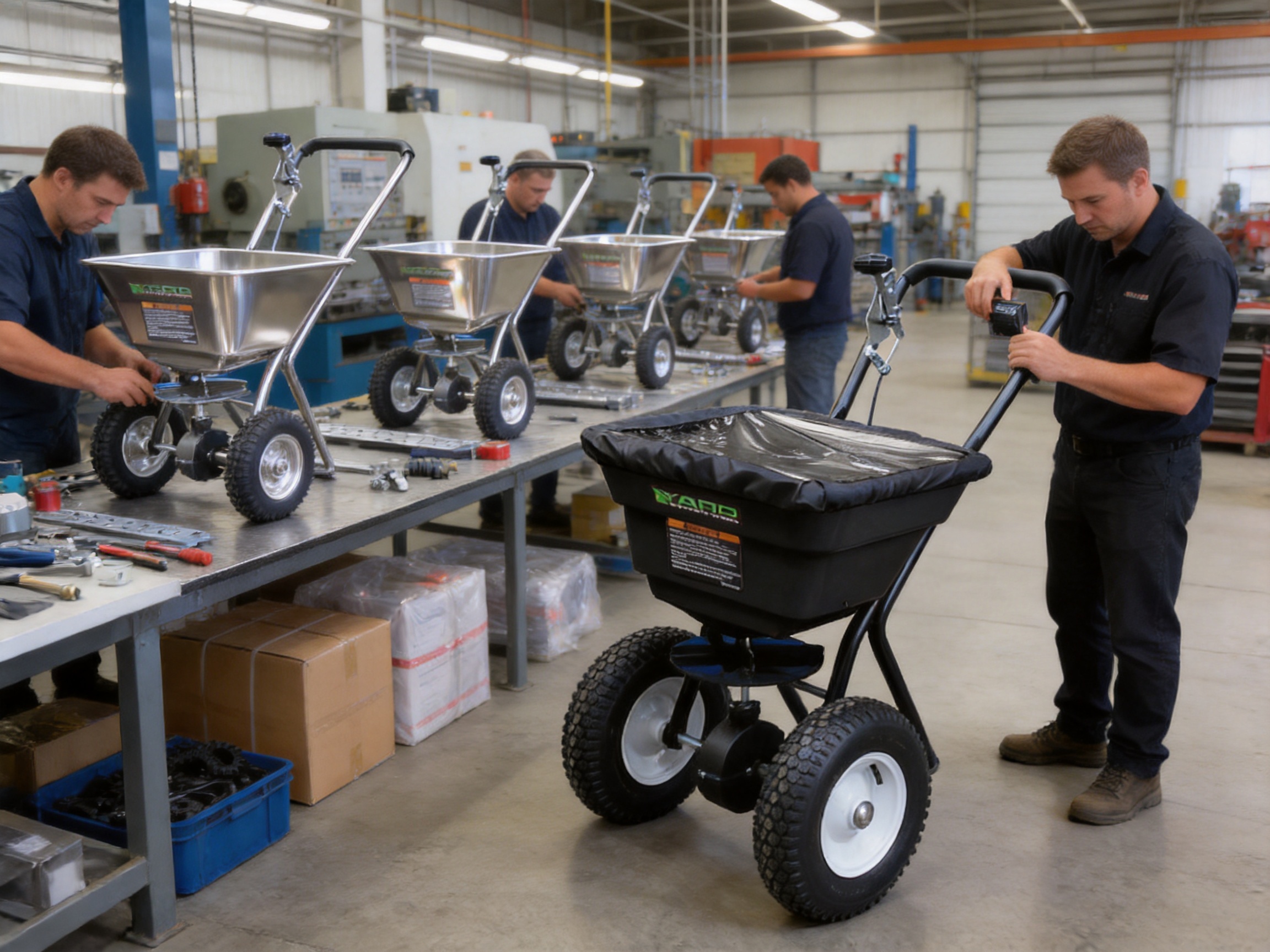
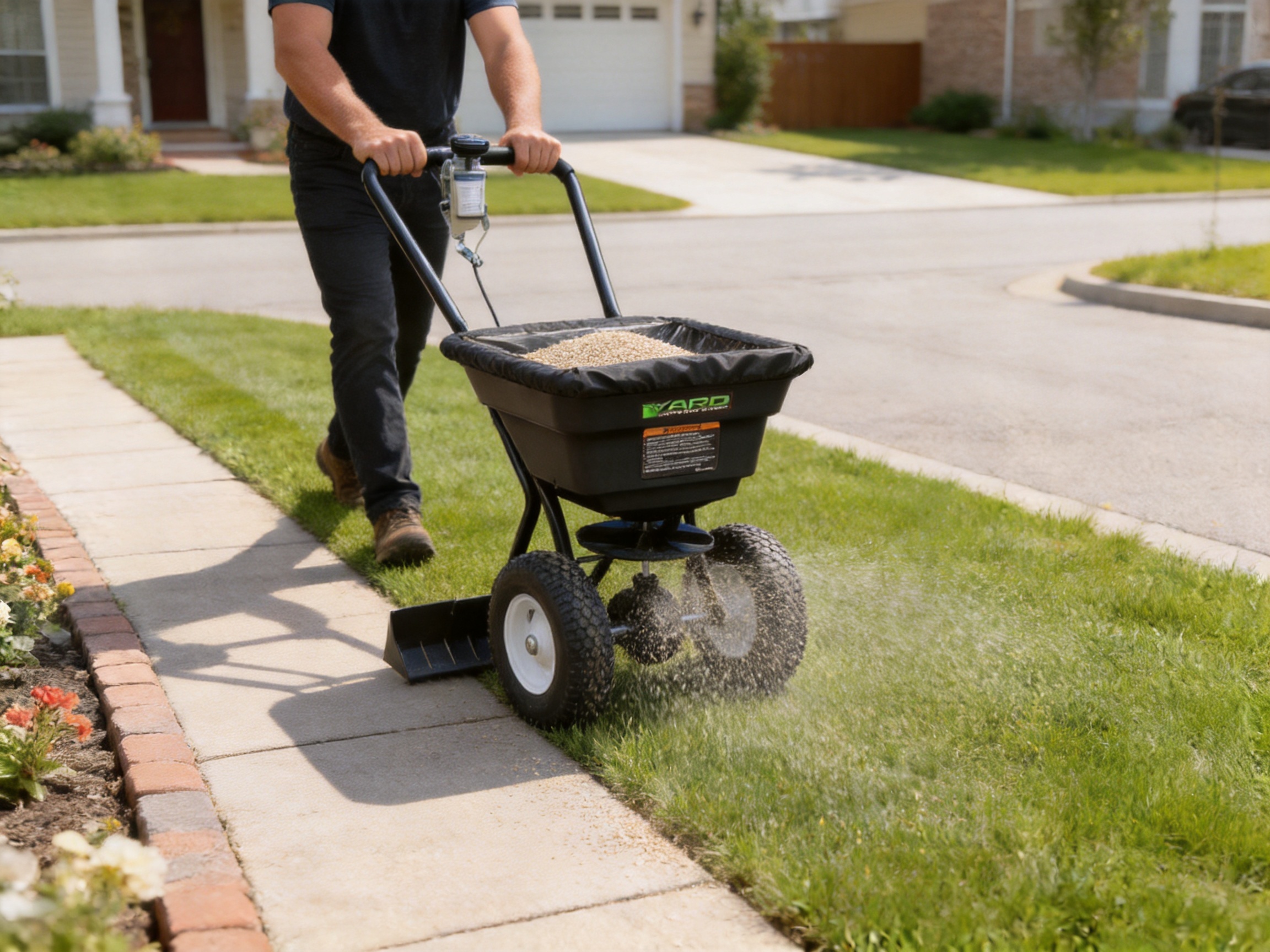
Modern lawn and property maintenance depends on equipment that can distribute materials evenly, operate comfortably, and withstand repeated outdoor use. A push spreader is one of the most practical tools for applying fertilizer, grass seed, ice-melting salt, and other granular materials across lawns, paths, driveways, and commercial grounds. The 80 lb Push Spreader SP31504 is designed to combine useful capacity, controlled application, durable construction, and straightforward operation in one manually propelled machine.
With an 80 lb or 29 L hopper, a spreading width of approximately 10 to 12 feet, a rate-setting control positioned on the handle, and large pneumatic tires, this model is intended to reduce the time and physical effort required for routine material distribution. Its stainless steel frame, gauge plate, wheel axle, vertical axle, and hardware provide an additional level of corrosion resistance and structural reliability that is especially valuable when the spreader is exposed to fertilizer, salt, moisture, soil, and changing weather conditions.
The product is manufactured by Jiashan Superpower Tools Co., Ltd., a Chinese manufacturer specializing in log splitters, lawn and garden equipment, dump carts, spreaders, lawn sweepers, lawn aerators, and other outdoor power equipment. The company has operated since 1997 and maintains an ISO 9001:2015-certified quality management system. Its experience in outdoor equipment production supports a manufacturing approach centered on practical design, controlled production, product consistency, and international market requirements.
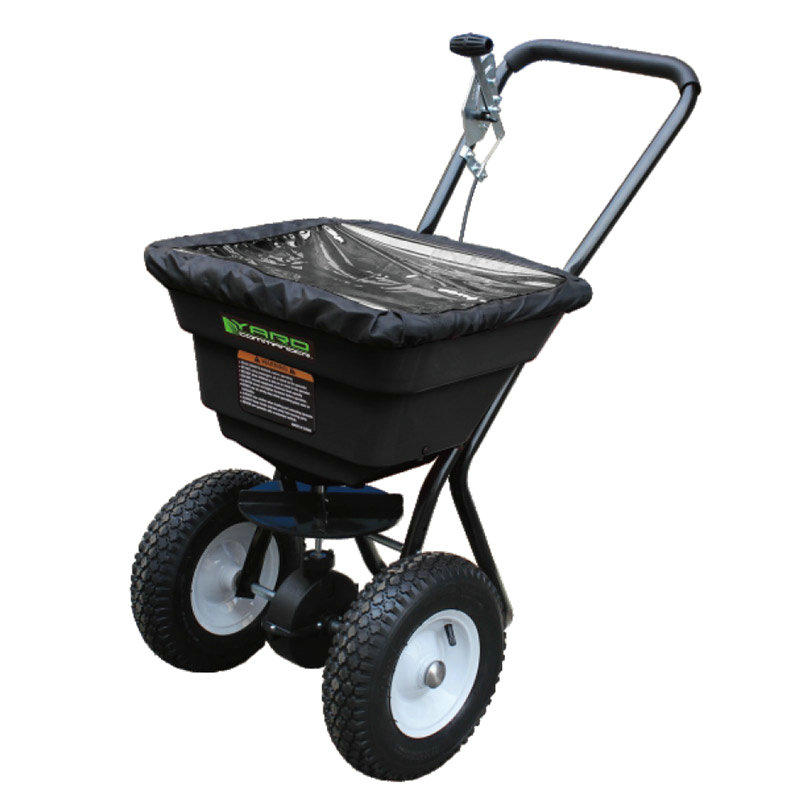
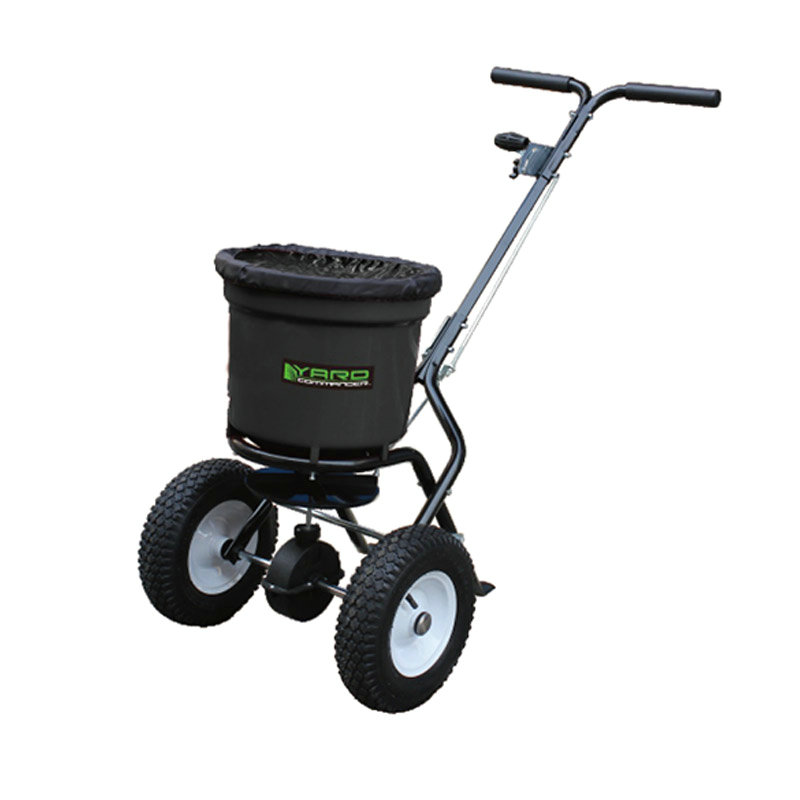
80lb. Push Spreader SP31504
Designed for Versatile Granular Material Distribution
The primary purpose of the SP31504 is to distribute granular materials over a predictable area. It can be used for fertilizer, grass seed, and salt, giving property owners, landscape contractors, facility managers, and equipment distributors a versatile tool for multiple seasons and applications.
Fertilizer distribution requires more than simply carrying material from one location to another. Uneven application can create over-fertilized patches, weak growth, discoloration, or wasted product. A spreader with a controlled discharge system helps the operator apply material more consistently while moving at a steady pace. The rate-setting control on the handle allows the operator to make adjustments without leaving the normal operating position, making it easier to respond to different materials, lawn conditions, or application requirements.
Grass seed presents a different challenge. Seed is usually lighter than fertilizer and may require a different opening or operating rate. The adjustable control allows the operator to adapt the spreader to the selected material instead of relying on one fixed setting. Although the correct setting should always be confirmed through a small test area and the instructions supplied with the material, an adjustable handle control provides a practical foundation for accurate application.
Salt spreading is another important use. During cold weather, salt can absorb moisture and become aggressive toward ordinary steel components. The SP31504 addresses this operating environment with stainless steel parts in key structural and material-contact areas. This does not remove the need for cleaning and maintenance after salt use, but it can help reduce corrosion-related deterioration compared with a spreader constructed entirely from untreated conventional steel.
Key Product Specifications
Model | SP31504 |
Product Type | Push Spreader |
Capacity | 80 lb / 29 L |
Spread Width | 10 to 12 ft / 3048 to 3658 mm |
Tire | 12 in / 350-6 pneumatic tire |
Gear | Nylon |
Construction Features | Stainless steel frame, gauge plate, wheel axle, vertical axle, and hardware |
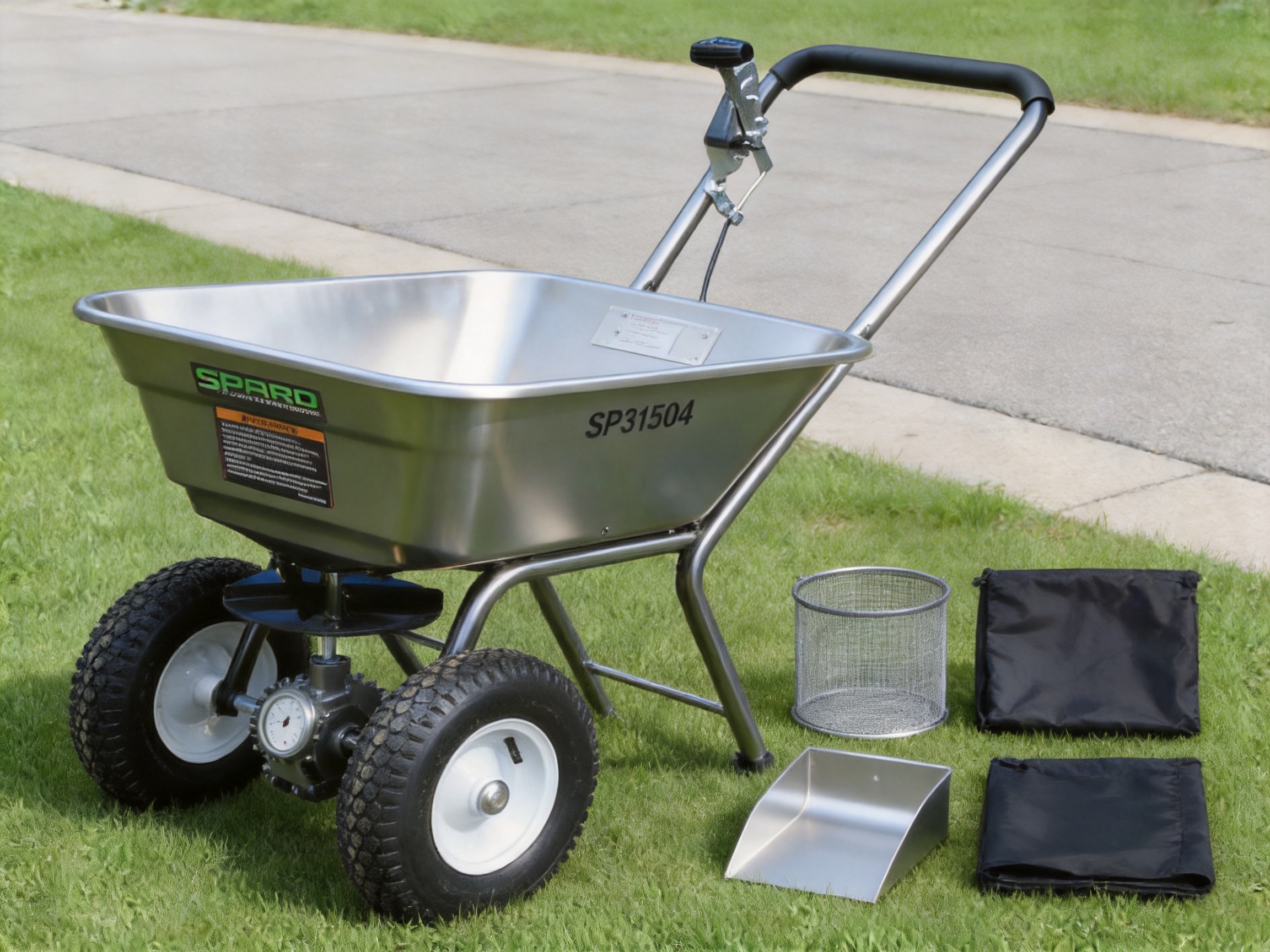
Accessories | Screen, rain cover, and deflector kit |
Control | Handle-mounted rate-setting control |
Net Weight | 23 lb / 10.4 kg |
Gross Weight | 26.4 lb / 12 kg |
Package Size | 24.4 x 16.5 x 12.6 in / 62 x 42 x 32 cm |
Container Quantity | 720 pieces per 40-foot GP container |
Capacity That Supports Efficient Work
An 80 lb capacity gives the operator a useful balance between productivity and maneuverability. A smaller hopper may need frequent refilling during a medium-sized lawn or commercial walkway application. Repeated stops interrupt the working pattern, increase handling time, and can make it more difficult to maintain consistent coverage. The SP31504 reduces the number of refills required for many routine jobs while remaining light enough to be pushed manually.
The stated 29 L capacity is a useful volume reference for distributors and users who measure materials by volume rather than weight. However, the actual weight that can be carried depends on material density. Fertilizer, grass seed, and salt do not have the same density, so users should avoid assuming that every material will fill the hopper to the same weight. The 80 lb rating provides a practical maximum reference, while responsible operation requires attention to the characteristics of the material being used.
Capacity also affects workflow. For residential users, the hopper can support lawn feeding, overseeding, and seasonal ice control with fewer interruptions. For landscaping businesses, grounds crews, schools, property managers, and small municipal operations, a larger working load can help improve productivity across paths, lawns, courtyards, and open landscaped areas.
The hopper should not be overloaded beyond its intended capacity. Excessive loading can increase rolling resistance, place unnecessary stress on the axle and drive system, and make the spreader more difficult to control. Loading a measured amount and keeping material distributed evenly in the hopper are simple practices that help preserve stability and improve application consistency.
Wide Coverage for Faster Application
The SP31504 has a spread width of approximately 10 to 12 feet, or 3048 to 3658 millimeters. A broad distribution pattern reduces the number of passes required to cover an open area. When the operator follows a straight route and maintains a suitable walking speed, the coverage width can help shorten working time compared with narrow spreading equipment.
A wide spread pattern must be managed carefully around flower beds, garden borders, water features, driveways, parked vehicles, and neighboring properties. The supplied deflector kit is useful for applications where material must be directed away from sensitive areas. It can help the operator keep granular products within the intended treatment zone instead of allowing them to reach pathways, decorative planting, or non-target surfaces.
Coverage width can vary with material type, granule size, moisture content, rate setting, and walking speed. For that reason, the stated 10 to 12 foot range should be treated as a working specification rather than a guarantee of identical performance for every product. A responsible operator should calibrate the spreader using the selected fertilizer, seed, or salt before beginning a full application.
Compared with basic low-capacity spreaders, the combination of a larger hopper and wide working path can offer a meaningful productivity advantage. The operator can cover more ground per pass and spend less time stopping to refill. Compared with heavy powered equipment, the manual push design remains relatively simple, quiet, and economical to operate, with no fuel or battery charging required.
Handle-Mounted Rate Control for Practical Precision
Application control is one of the most important characteristics of any broadcast spreader. The SP31504 places its rate-setting control on the handle, keeping the adjustment within reach while the operator is standing behind the machine. This arrangement supports a natural operating posture and avoids the inconvenience of reaching down toward the hopper during work.
The control can be adjusted according to the material and the desired application rate. Fertilizer products may require a different opening from grass seed, while salt application may depend on weather conditions, surface type, and the level of ice control required. A clearly understood adjustment system gives the operator more flexibility than a fixed-output design.
Precision depends on more than the control itself. The operator should use a consistent walking pace, avoid sudden changes in direction, and maintain an overlapping route when recommended by the material manufacturer. The hopper should be filled with care, and the spreader should be tested over a measured distance. These methods help convert the mechanical adjustment into a more reliable real-world application pattern.
A handle-mounted control is also beneficial when a user needs to make small corrections while moving between different surfaces. A lawn, gravel path, concrete driveway, and compacted soil may produce different rolling conditions. Being able to adjust the rate without stopping can make the workflow more responsive and convenient.
Solid Linkage and Mechanical Reliability
The product is specified with solid linkage, a feature that supports direct mechanical operation between the handle control and the discharge mechanism. A robust linkage helps reduce unwanted movement and can provide a more positive response when the operator changes the setting. This is particularly valuable in a manual spreader, where the reliability of the adjustment system contributes directly to application consistency.
Mechanical simplicity is an advantage in outdoor equipment. Unlike powered machines with engines, electrical systems, fuel lines, and complex controls, a push spreader has fewer operating systems that can fail. The SP31504 focuses on a straightforward mechanical arrangement that can be inspected, cleaned, and maintained by the user or service provider.
Solid linkage does not eliminate the need for care. Granular material can collect around moving parts, and damp fertilizer or salt may harden if left in the machine. Cleaning the control area and discharge mechanism after use helps preserve free movement. Users should also check that fasteners remain secure and that the linkage moves smoothly before beginning a new application.
Stainless Steel Construction for Demanding Outdoor Conditions
One of the strongest differentiating features of the SP31504 is the use of stainless steel for several important components. The listed stainless steel parts include the frame, gauge plate, wheel axle, vertical axle, and hardware. These components are exposed to structural loads, contact with granular materials, moisture, and the corrosive effects of fertilizer or salt. Stainless steel construction can provide improved resistance to rust and surface deterioration compared with ordinary unprotected steel.
The stainless steel frame contributes to long-term structural integrity. The frame supports the hopper, wheels, handle, control system, and drive components, so it is central to the overall stability of the machine. A corrosion-resistant frame is especially useful for users who store equipment in sheds, garages, outdoor storage areas, or commercial maintenance facilities where humidity and seasonal chemicals may be present.
The stainless steel gauge plate helps protect an important area near the rate-setting and discharge mechanism. Since this part may be exposed to material dust and moisture, corrosion resistance can help preserve the visibility and operation of the adjustment system.
The wheel axle and vertical axle are also significant. These parts carry movement-related loads and are located near the wheels and lower material-handling area. Stainless construction supports durability in an area that may be exposed to mud, wet grass, fertilizer residue, and de-icing salt.
Stainless hardware can provide an advantage during maintenance as well. Fasteners that resist corrosion are less likely to seize or become difficult to remove after outdoor exposure. This can make future adjustment, inspection, or replacement work more manageable. Nevertheless, stainless steel should not be regarded as maintenance-free. Rinsing away chemical residue, drying the spreader, and storing it under cover remain important practices.
12-Inch Pneumatic Tires for Improved Mobility
The SP31504 uses 12-inch 350-6 pneumatic tires. Pneumatic tires are suitable for a wide variety of lawn and property surfaces because the air-filled construction can absorb some vibration and adapt to minor irregularities in the ground. Compared with small hard wheels, larger pneumatic tires may roll more smoothly across grass, compacted soil, gravel, and uneven transitions.
Larger wheels also help reduce the effort required to push a loaded spreader over ordinary outdoor surfaces. The wheel diameter allows the machine to pass over small surface irregularities more easily than a very small-wheel design. This can be useful when moving between turf, pavement, and light gravel.
Tire pressure should be checked periodically. Underinflation may increase rolling resistance and make steering less predictable, while excessive pressure may reduce comfort and traction. The tires should be inspected for cuts, embedded objects, and signs of damage. Because the spreader is manually propelled, proper tire condition contributes both to productivity and operator comfort.
The pneumatic tire specification also supports easier handling during storage and transport. The product has a net weight of 23 lb, which is relatively manageable for a manually operated spreader. Its weight provides enough substance for stable movement while avoiding the excessive bulk associated with heavier commercial machines.
Nylon Gear for Smooth, Lightweight Operation
The drive gear is specified as nylon. Nylon gears are commonly used in lawn and garden equipment because they are lightweight, resistant to many forms of ordinary wear, and capable of operating with relatively low noise. Their use can help maintain a practical balance between operating performance, product weight, and manufacturing cost.
A nylon gear can also contribute to quieter operation than a comparable metal gear system. This is useful for residential users and for grounds crews working around schools, offices, parks, or occupied facilities where unnecessary noise is undesirable.
Like any gear, a nylon gear benefits from protection against abrasive contamination and impact loading. Operators should avoid forcing the spreader over obstacles or pushing it with excessive weight beyond the intended capacity. Material residue should be removed after use, and the gear area should be inspected as part of routine maintenance. When operated within its intended conditions, the nylon gear supports a simple and efficient drive arrangement.
Screen, Rain Cover, and Deflector Kit
The accessory package includes a screen, rain cover, and deflector kit. Each accessory addresses a different operating need and adds practical value beyond the basic spreading function.
Screen
The screen can help filter or break up material as it enters the hopper and discharge area. Granular products may contain lumps, oversized particles, or compacted sections caused by humidity and storage. A screen can help reduce the passage of unsuitable pieces into the spreading mechanism, supporting smoother material flow and helping protect against blockages.
Users should still inspect fertilizer, seed, or salt before loading the hopper. A screen is not a replacement for proper material storage or preparation. Keeping products dry and following the instructions supplied by the material manufacturer will improve results.
Rain Cover
The rain cover provides protection for the hopper and material when changing weather conditions threaten an outdoor application. Rain can alter the flow characteristics of fertilizer, seed, and salt. Wet material may clump, bridge over the outlet, or produce an inconsistent pattern. A cover can help shield the hopper during light rain or brief exposure while the operator completes a task or moves the machine between locations.
The cover should not be considered a substitute for indoor storage. At the end of an application, material should be removed from the spreader, and the equipment should be cleaned and dried. The cover is most effective as an operational accessory rather than a permanent storage solution.
Deflector Kit
The deflector kit supports controlled application near boundaries. It can be helpful when spreading along sidewalks, garden edges, buildings, driveways, or property lines. By limiting the direction of discharged material, the deflector can reduce unwanted application outside the target area.
This accessory is particularly useful for salt. Applying more salt than necessary can waste material and may affect vegetation, masonry, metal surfaces, and drainage areas. Directing the material toward the required treatment zone helps improve resource efficiency and supports more responsible maintenance.
Advantages Compared with Basic Competing Spreaders
Product comparisons should consider the complete operating system rather than one isolated specification. The SP31504 offers several practical advantages over basic spreaders that may have smaller hoppers, narrow wheels, limited adjustment systems, or less corrosion-resistant construction.
Greater Working Capacity
An 80 lb hopper can reduce refill frequency compared with compact residential spreaders. Fewer refills can improve productivity and make it easier to maintain a consistent route. The capacity is suitable for many household, landscaping, commercial property, and seasonal maintenance applications.
Broad Application Width
The 10 to 12 foot spread width supports faster coverage across open lawns and paved areas. A broader pattern can reduce the number of passes required, provided that the operator calibrates the machine and uses an appropriate overlapping route.
More Accessible Adjustment
The handle-mounted rate control is more convenient than an adjustment system located low on the hopper or near the discharge opening. It allows the operator to make changes while maintaining a normal pushing position.
Improved Corrosion Resistance
The use of stainless steel in the frame, axles, gauge plate, and hardware distinguishes the product from many entry-level spreaders that depend primarily on painted or untreated steel. This feature is valuable for fertilizer and salt applications, where chemical residue and moisture can accelerate corrosion.
Practical Mobility
The 12-inch pneumatic tires support movement across a range of outdoor surfaces. Their size and air-filled construction can improve comfort and rolling performance compared with narrow, rigid wheels.
Useful Accessories
The supplied screen, rain cover, and deflector kit give the operator more control over material flow and application boundaries. These features add versatility without requiring a powered system or complicated electronic controls.
Lower Operating Complexity
As a manual push spreader, the SP31504 does not require gasoline, engine oil, fuel storage, battery charging, or electrical power. This lowers routine operating complexity and can make the equipment attractive to users who prioritize simple, quiet, and easily accessible lawn-care tools.
Advantages Compared with Heavy Powered Equipment
Powered broadcast spreaders may be appropriate for very large sites, but they are not always the most economical or convenient choice. The SP31504 can be advantageous when the work area is moderate, when quiet operation is preferred, or when the operator needs a machine that can be used immediately without fueling or charging.
A manual spreader produces no exhaust during operation and does not depend on an engine. This can be beneficial around homes, enclosed courtyards, schools, public walkways, and other locations where emissions or engine noise may be undesirable. The operator also avoids many engine-related maintenance tasks, including oil changes, spark plug replacement, fuel-system cleaning, and seasonal fuel management.
Manual operation can provide better control in narrow or irregular areas. The user can stop immediately, reposition the machine, or adjust the application rate without managing an engine throttle. For smaller properties and targeted jobs, the simplicity of a push spreader may be more valuable than the higher output of a powered machine.
The main trade-off is that manual operation depends on the operator’s pace and physical effort. The SP31504 is not intended to replace large commercial spreaders for extensive acreage. Its strength is the combination of meaningful capacity, broad coverage, and manageable manual operation for routine property maintenance.
Manufacturing Experience and Production Strengths
The manufacturer, Jiashan Superpower Tools Co., Ltd., specializes in outdoor power equipment and lawn and garden tools. Its product range includes log splitters, dump carts, spreaders, lawn sweepers, lawn aerators, and related equipment. This product concentration is important because it indicates familiarity with the conditions that affect outdoor machinery: changing weather, soil contact, abrasive materials, corrosion, repeated transport, and seasonal storage.
Established in 1997, the company has more than two decades of manufacturing experience. Long-term operation in the outdoor equipment sector can support accumulated knowledge in product development, supplier coordination, assembly methods, quality inspection, packaging, and export logistics.
The company operates from Jiashan in Zhejiang Province, between Shanghai and Hangzhou. The manufacturing facility is located in the Huimin Economic Development Zone. This location provides access to established industrial infrastructure, component suppliers, transportation networks, and export channels. These factors can support stable production planning and efficient shipment preparation for international customers.
The company maintains an ISO 9001:2015-certified quality management system. ISO 9001 is associated with documented quality processes, controlled procedures, customer-focused planning, corrective action, and continual improvement. Certification does not mean that every product is identical under every condition, but it demonstrates that the manufacturer has established a formal framework for managing production and quality responsibilities.
Many of the company’s products carry CE certification. For international buyers, certification and compliance capabilities can simplify product evaluation and support access to markets with specific safety and documentation expectations. Customers should confirm the exact certification and applicable documentation for the model and destination market they are purchasing.
Advanced Manufacturing Processes Supporting Product Quality
The product’s performance depends on the interaction of design, material selection, fabrication, assembly, inspection, and packaging. A manufacturer experienced in outdoor equipment can apply specialized processes across these stages.
Material Selection
Choosing stainless steel for critical structural and exposed parts is a design and manufacturing decision that addresses corrosion risk at the source. The frame, axles, gauge plate, and hardware must be formed, cut, finished, and assembled with attention to dimensional accuracy and surface condition. Appropriate material selection helps create a more durable foundation for the finished product.
Component Fabrication
Outdoor equipment components commonly require cutting, bending, forming, drilling, welding, and finishing. Consistency in these operations is necessary for correct alignment of the frame, wheel axle, vertical axle, hopper, and control system. Accurate fabrication helps ensure that the wheels track properly and that the rate-control linkage operates as intended.
Assembly Control
Assembly quality influences the way a spreader performs in the field. The handle, linkage, gear, wheel system, hopper, gauge plate, and discharge components must be fitted in the correct sequence and secured with appropriate hardware. Controlled assembly procedures help reduce variation between units and make the equipment more predictable for distributors and end users.
Functional Inspection
A responsible production process includes checks of important functions, such as wheel movement, linkage operation, rate-control response, hopper fit, and general structural stability. Inspection can identify loose fasteners, misalignment, surface defects, or incomplete assembly before products are packed for shipment.
Packaging Development
The stated package size is 24.4 by 16.5 by 12.6 inches, or 62 by 42 by 32 centimeters. Efficient packaging protects the product while using space effectively during storage and transport. The listed container quantity of 720 pieces per 40-foot general-purpose container indicates that the product is designed for organized international distribution and volume shipment.
Good packaging is especially important for outdoor equipment because components can be exposed to impact, vibration, compression, and humidity during transport. Proper internal protection, clear assembly information, and organized hardware can reduce the risk of damage and improve the customer’s first experience with the product.
Quality Management for International Markets
Outdoor equipment is sold in markets with different climates, work habits, labeling expectations, and regulatory requirements. A manufacturer serving North America, Europe, Australia, Asia, South America, and other regions must account for these variations in product development and supply-chain management.
International distribution requires more than producing a functional machine. It also involves consistent specifications, accurate packaging information, export documentation, product identification, and communication with distributors. A formal quality management system can help coordinate these requirements across departments and production stages.
The company’s focus on innovative, energy-efficient, environmentally friendly, and cost-effective products aligns with the needs of customers who want practical equipment without unnecessary operating expense. In the case of a manual push spreader, energy efficiency is expressed through human-powered operation, no fuel consumption during use, and a design intended to perform multiple material-distribution tasks.
Recommended Operating Practices
Before use, inspect the spreader for loose hardware, damaged components, tire problems, or contamination in the hopper and discharge area. Confirm that the handle-mounted rate control moves smoothly and that the linkage responds to adjustment. Make sure the wheels rotate freely and that the hopper is securely connected to the frame.
Use only clean, flowable material suitable for broadcast spreading. Break up or remove large lumps before loading. Do not mix incompatible materials, and follow the application instructions supplied by the fertilizer, seed, or salt manufacturer.
Calibrate the spreader in a small test area. Measure the application zone, select an initial rate, and observe the coverage. Adjust the setting gradually until the desired result is achieved. Calibration should be repeated when changing from fertilizer to seed or salt because material density and granule shape affect flow.
Maintain a steady walking speed. Sudden acceleration, abrupt stops, and irregular turns may affect distribution. Follow a planned route, use suitable overlap where necessary, and keep the deflector in place when working near boundaries.
Do not operate the machine beyond its intended capacity. Excessive loading can affect control, increase stress on the gear and axle system, and make pushing more difficult. If the spreader becomes difficult to move, stop and investigate rather than forcing it over an obstacle.
Cleaning and Maintenance
Cleaning is especially important after fertilizer or salt use. Empty all remaining material from the hopper and discharge system. Brush away dry residue, then rinse appropriate surfaces with clean water when suitable. Avoid leaving water trapped around bearings, gears, fasteners, or control components. Dry the spreader thoroughly before storage.
Salt residue should be removed as soon as practical because prolonged exposure may contribute to corrosion, even when stainless steel components are used. Fertilizer residue can also absorb moisture and harden, potentially restricting the rate mechanism or discharge opening.
Inspect the pneumatic tires and maintain appropriate inflation. Examine the gear and linkage for debris or wear. Check the frame, axles, gauge plate, and hardware for damage or loosening. Tighten fasteners according to appropriate maintenance guidance, but do not overtighten components that require free movement.
Store the spreader in a dry, covered location. Keep the rain cover clean and dry, and do not store wet material inside the hopper. Seasonal storage should include a complete cleaning, a detailed inspection, and protection from unnecessary exposure to direct rain, snow, and standing moisture.
Applications Across Different User Groups
Residential Lawn Care
Homeowners can use the spreader for seasonal fertilizer applications, grass seeding, and winter salt distribution. The 80 lb capacity is suitable for many residential properties, while the pneumatic tires support movement across lawns and driveways.
Landscaping Contractors
Professional landscapers can benefit from a versatile spreader that handles several common materials. The broad spread width can improve job-site productivity, and the stainless steel construction is useful when equipment is moved between different properties and exposed to varied conditions.
Property Management
Apartment complexes, office parks, schools, retail properties, and small industrial sites often need equipment for both lawn improvement and seasonal ice control. A single push spreader that can handle fertilizer, seed, and salt can simplify equipment planning and reduce the need for separate tools.
Municipal and Institutional Maintenance
Public paths, courtyards, parks, and facility grounds may require targeted material application. The deflector kit can help control coverage near boundaries, while the manual design avoids fuel and engine noise in areas used by pedestrians.
Equipment Distributors
Dealers and importers may find the product suitable for customers seeking a mid-capacity spreader with corrosion-resistant components and useful accessories. Its package size and container quantity also support organized wholesale distribution.
Why Material Compatibility and Calibration Matter
No spreader can provide identical output for every granular product. Fertilizer granules vary in size, density, shape, and moisture content. Grass seed can be light and irregular, while salt may become damp or compacted. These differences affect the way material moves through the hopper, passes the gauge plate, and leaves the discharge system.
The stated spread width and capacity are important reference points, but field performance depends on the selected material and operating method. Calibration helps the user identify a suitable rate setting. Testing also reveals whether the material is flowing freely or whether it requires screening, drying, or preparation.
Users should not rely only on a number printed on the control. The correct setting may vary according to product formulation, environmental conditions, walking speed, and the desired application rate. A small test area protects the rest of the property from accidental over-application and helps conserve material.
Environmental and Cost Benefits
The manual design eliminates fuel consumption and direct exhaust emissions during operation. It also avoids battery charging requirements, which can be useful for users who need equipment that is always ready for short tasks. Quiet operation can reduce disturbance to households, neighbors, employees, students, and visitors.
Efficient spreading can reduce wasted fertilizer, seed, and salt. The rate-setting control and deflector kit support better control, while the broad coverage width can reduce the time and energy required to complete a job. Proper calibration is essential because applying excess material increases cost and may create environmental concerns.
Durable, corrosion-resistant construction can support a longer service life when the equipment is maintained correctly. Extending the useful life of a tool reduces the frequency of replacement and helps users obtain greater value from their investment. The most sustainable operating result comes from combining durable materials with responsible use, cleaning, repair, and storage.
Purchasing Considerations for Wholesale Buyers
Wholesale customers should evaluate more than the unit price. Important factors include capacity, product dimensions, package size, container loading quantity, material specifications, accessories, certification documentation, spare-part support, and expected service conditions.
The 720-piece loading quantity for a 40-foot general-purpose container provides a useful planning reference for importers. Buyers should confirm the final loading arrangement, packaging configuration, and shipping requirements before placing an order. They should also verify whether the product is supplied assembled or requires customer assembly, and whether instruction materials are available in the required language.
Distributors should explain correct use to customers, including material compatibility, calibration, cleaning, and storage. Clear sales information helps prevent misuse and improves customer satisfaction. It is also useful to identify whether local markets require specific labels, manuals, warnings, or conformity documents.
Because this model is designed for international distribution, communication between the manufacturer and buyer is important. Product specifications, quality expectations, packaging marks, inspection requirements, and delivery schedules should be agreed upon in writing before production and shipment.
Q&A
What materials can the SP31504 spread?
The spreader is designed for fertilizer, grass seed, and salt. Other granular products may be suitable if they flow freely and are compatible with the equipment, but users should test unfamiliar materials carefully and follow the material manufacturer’s application instructions.
How much material can it hold?
The stated capacity is 80 lb or 29 L. The actual weight that can be carried depends on material density, so a full hopper will not necessarily weigh the same amount for fertilizer, seed, and salt.
How wide is the spreading pattern?
The specified spread width is approximately 10 to 12 feet, equivalent to 3048 to 3658 millimeters. Actual coverage depends on material characteristics, rate setting, walking speed, and operating conditions.
Is the spreader powered by an engine or battery?
No. It is a manually operated push spreader. It does not require gasoline, engine oil, or battery charging.
Why are stainless steel components important?
Stainless steel provides improved resistance to rust and corrosion compared with ordinary unprotected steel. This is useful because fertilizer, salt, moisture, and outdoor storage can be demanding on equipment. Regular cleaning is still required.
What does the rain cover do?
The rain cover helps protect material in the hopper during brief exposure to wet weather. It is not a replacement for emptying, cleaning, drying, and storing the spreader in a covered location.
What is the purpose of the deflector kit?
The deflector kit helps direct material away from areas that should not receive fertilizer, seed, or salt. It is useful near flower beds, driveways, paths, property boundaries, and other sensitive areas.
Are pneumatic tires better than solid wheels?
Pneumatic tires can provide a smoother ride and may handle uneven outdoor surfaces more comfortably. They require periodic pressure checks and inspection for damage, while solid wheels generally do not require inflation.
Does the spreader need calibration?
Yes. Calibration is recommended whenever the material changes or when a new application rate is required. A test over a measured area helps the operator select a suitable setting and confirm the coverage pattern.
Can it be used for commercial work?
It can be suitable for landscaping, property management, institutional grounds, and other moderate-duty applications. Large commercial operations covering extensive acreage may require powered equipment with higher output.
How should it be cleaned after spreading salt?
Empty the hopper, remove residue, rinse suitable surfaces with clean water, and dry the spreader thoroughly. Salt should not be left inside the hopper or around the gear, axles, linkage, and fasteners.
What manufacturing qualifications does the supplier have?
The supplier has manufactured log splitters and lawn and garden equipment since 1997, operates an ISO 9001:2015-certified quality management system, and supplies products to customers in multiple international markets. Many of its products carry CE certification, subject to the specific model and market requirements.
Conclusion
The 80 lb Push Spreader SP31504 is a versatile manual spreading solution for fertilizer, grass seed, salt, and similar granular materials. Its combination of 80 lb capacity, 10 to 12 foot spread width, handle-mounted rate control, solid linkage, 12-inch pneumatic tires, nylon gear, and practical accessories supports efficient property maintenance across residential, commercial, institutional, and landscaping applications.
Its most notable advantage is the use of stainless steel in the frame, gauge plate, wheel axle, vertical axle, and hardware. This construction addresses one of the major challenges faced by outdoor spreaders: exposure to moisture and chemically active materials. When combined with proper cleaning and storage, the corrosion-resistant design can support dependable long-term use.
The product also benefits from a manufacturer with more than two decades of outdoor equipment experience, an ISO 9001:2015-certified quality management system, international distribution capability, and expertise in related lawn and garden machinery. These strengths support a production approach that emphasizes practical engineering, controlled assembly, quality management, efficient packaging, and market adaptability.
For users who need more capacity and durability than a basic residential spreader but do not require a large powered machine, the SP31504 offers a balanced alternative. Its manual operation keeps the design simple and economical, while its adjustable control and accessories provide useful flexibility. With correct calibration, responsible loading, regular cleaning, and routine inspection, it can become a dependable tool for year-round lawn and property care.
References
1. Product specification sheet for the 80 lb Push Spreader SP31504, including capacity, spread width, tire, gear, construction, packaging, and weight information.
2. Manufacturer-provided product description for the SP31504, including material applications, accessories, rate-setting control, solid linkage, and stainless steel components.
3. Company information for Jiashan Superpower Tools Co., Ltd., including manufacturing history, product categories, facility location, quality management system, and international market experience.
4. ISO 9001:2015 quality management system principles, including process control, customer focus, documented procedures, corrective action, and continual improvement.
5. General outdoor equipment maintenance practices for cleaning, corrosion prevention, pneumatic tire inspection, granular material handling, and seasonal storage.
Product: 80lb. Push Spreader SP31504
PREV:400lb Wooden Cart SP22106: A Practical High-Capacity Solution for Lawn and Garden Work
NEXT:12-Ton Electric Log Splitter: Performance, Design, Manufacturing Quality, and Buying Guide
NEXT:12-Ton Electric Log Splitter: Performance, Design, Manufacturing Quality, and Buying Guide
Interested in cooperation or have questions?
Related products
-
-
-
-
DESCRIPTION ♦Spread for fertilizer, grass seeds, salt ♦A...
See Details -
DESCRIPTION ♦Heavy duty nylon gear ♦Accessories: screen & rain cov...
See Details