
 LANGUAGE
 English
 Deutsch
 Español
 Français
 русский

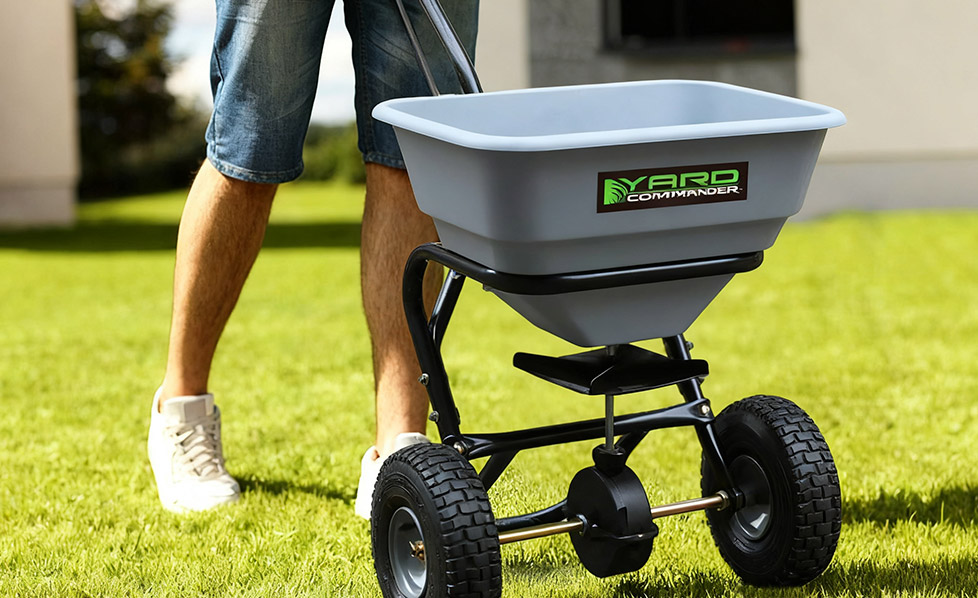









DESCRIPTION ♦Rust resistant powder coat finish ♦Removabl...
See Details
70 lb Tow Spreader SP31575: Practical Year-Round Material Distribution for Lawns and Grounds
Reliable material distribution is an essential part of lawn care, property maintenance, sports-ground management, landscaping, agricultural support work, and winter surface treatment. A spreader must do more than hold fertilizer or ice melt. It must connect securely to a towing vehicle, distribute material consistently, withstand outdoor exposure, and remain simple enough to operate during routine work. The 70 lb Tow Spreader SP31575 is designed around these practical requirements.
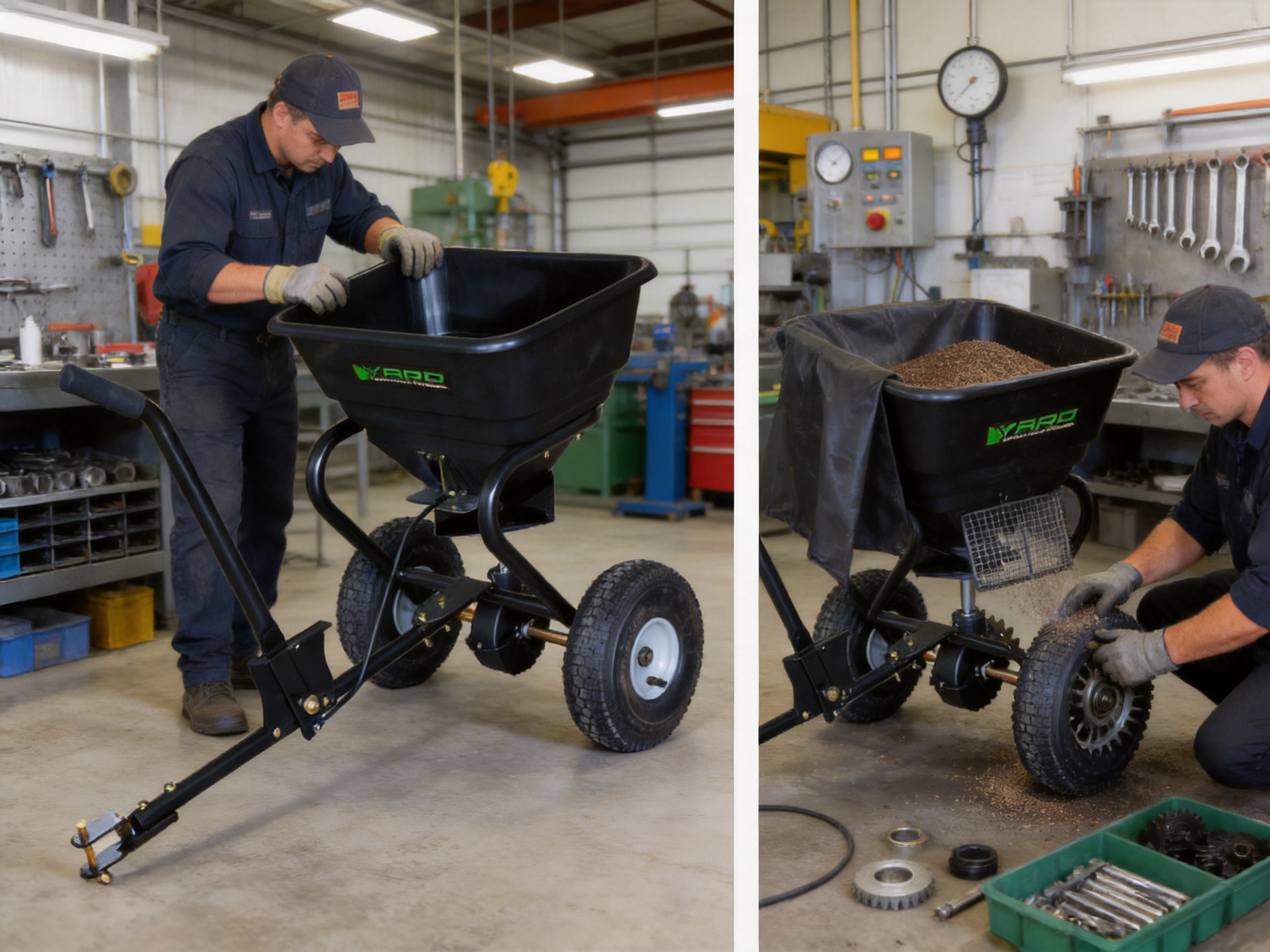
With a 70 lb capacity, a rust-resistant powder coat finish, pneumatic tires, a metal gear system, a screen, and a rain cover, the SP31575 provides a useful combination of capacity and operating convenience. It is intended for use with lawn and garden tractors and ATVs, allowing the operator to cover larger areas without carrying a handheld hopper or repeatedly stopping to refill a small walk-behind unit.
The spreader is also designed for year-round service. Fertilizer and grass seed can be distributed during the growing season, while ice melt and similar materials can be applied during colder months. This multi-season capability gives the unit broader practical value than a product designed for only one type of material or one period of the year.
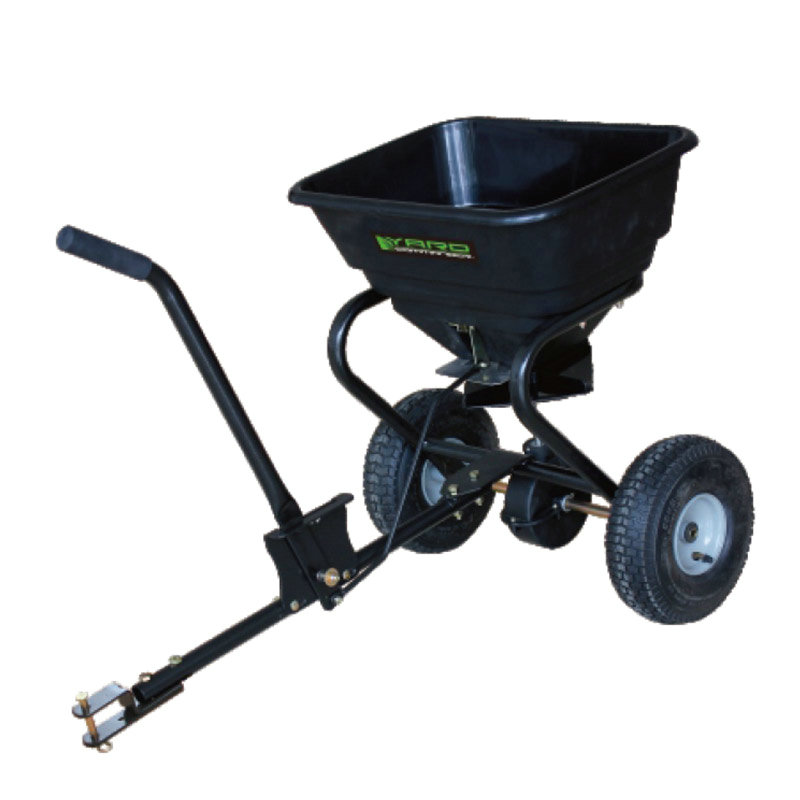
70lb. Tow Spreader SP31575
Product Overview
The SP31575 is a tow-behind spreader with a stated capacity of 70 lb or 26 L. It is built for attachment behind compatible lawn tractors, garden tractors, and all-terrain vehicles. Once connected, the spreader uses the towing vehicle’s movement to transport material across the work area while the operator controls the flow from the driver’s seat.
The product includes a flow control lever positioned for convenient operation. This feature allows the operator to start, stop, or adjust material delivery without dismounting from the towing vehicle. For larger lawns, long driveways, commercial grounds, and properties with multiple treatment areas, the ability to control distribution from the seat can save time and reduce unnecessary movement.
The spreader’s stated spread width is approximately 10 to 12 feet, shown in the product information as 3048 to 3658 mm. Actual coverage can vary according to material density, particle size, moisture, travel speed, spinner adjustment, and operating conditions. Even so, a working width in this range is suitable for covering open lawn areas efficiently while allowing the operator to make overlapping passes where necessary.
Two pneumatic tires support the spreader during towing. The listed tire specification is 10 inches, 350-4. Pneumatic tires can help the unit travel over ordinary lawn surfaces, compacted soil, gravel paths, and similar terrain with more cushioning than small solid wheels. The tires also help maintain contact with uneven ground while the spreader is being pulled behind a tractor or ATV.
A metal gear system is included in the design. The gear assembly transfers motion from the wheels to the spreading mechanism. Compared with a basic unit using lighter-duty plastic drive components, a metal gear system can offer a more substantial solution for repeated outdoor use, provided it is properly maintained and operated within the product’s intended capacity.
Key Specifications
| Specification | Product Information |
|---|---|
| Product | 70 lb Tow Spreader SP31575 |
| Category | Tow Behind Spreader |
| Model | SP31575 |
| Capacity | 70 lb / 26 L |
| Spread Width | Approximately 10–12 ft / 3048–3658 mm |
| Pneumatic Tire | 10 in, 350-4 |
| Gear | Metal |
| Accessories | Screen and rain cover |
| Package Size | 22.6 × 16.1 × 27 in / 57.5 × 41 × 68.5 cm |
| Net Weight | 23.2 lb / 10.53 kg |
| Gross Weight | 28.22 lb / 12.8 kg |
| Container Quantity | 408 pieces per 40-foot high-cube container |
The capacity specification combines a weight figure and a volume figure. Since different materials have different bulk densities, the amount held by volume may not correspond to the same weight for fertilizer, grass seed, salt, or ice melt. Operators should follow the recommended loading limits and avoid using the spreader beyond its rated capacity.
Advantages of a Tow-Behind Configuration
A tow-behind spreader provides a different operating experience from a handheld or push spreader. The weight of the loaded hopper is carried by the spreader and supported through its wheels and hitch rather than by the operator. This is especially valuable when treating larger areas or when the material is dense and heavy.
The tow-behind arrangement also improves productivity. A tractor or ATV can travel at a consistent speed while the spreader distributes material across the working path. The operator does not need to walk behind the equipment, carry a loaded hopper, or repeatedly stop to rest. This can make a significant difference on estates, parks, large residential properties, farms, nurseries, and commercial grounds.
Compared with smaller walk-behind units, the SP31575 is better suited to users who already own a compatible towing vehicle. The vehicle can provide the pulling power needed to move across wider spaces, while the spreader remains compact enough to store and transport without requiring a large commercial machine.
Another benefit is visibility. When the operator sits on the tractor or ATV, the towing position can make it easier to observe the treatment path, property boundaries, obstacles, and material flow. Good visibility supports more controlled application and can help reduce accidental treatment of flower beds, ponds, paved surfaces, or areas that should not receive fertilizer or ice melt.
Flow Control from the Driver’s Seat
The flow control lever is one of the most important convenience features of the SP31575. The operator can manage material delivery from the driver’s seat instead of stopping the vehicle and walking back to the hopper. This helps maintain a more efficient work rhythm, particularly when traveling between treated and untreated areas.
Seat-level control is also useful at the beginning and end of each pass. The operator can close or reduce the flow before reaching a boundary, then reopen it when entering the next treatment lane. This approach may help limit waste at the ends of lawns, around sidewalks, and near garden borders.
Material flow should always be adjusted according to the material being used. Fine fertilizer, coarse granules, seed, and ice melt do not behave identically. Moisture can cause clumping, while lightweight particles may respond differently to the spreader’s settings than dense granules. Operators should test the setting over a small area before beginning a full application.
The flow control system also supports seasonal versatility. During summer or spring use, it can regulate fertilizer and seed. In winter, the same control function can help manage ice melt on driveways, private roads, paths, and other suitable surfaces. The operator should confirm that the chosen material is compatible with the spreader and should clean the unit after corrosive materials are used.
Rust-Resistant Powder Coat Finish
Outdoor equipment is exposed to moisture, soil, fertilizer dust, temperature changes, and ultraviolet light. A rust-resistant powder coat finish provides a protective surface intended to help the spreader withstand these conditions better than an untreated metal finish.
Powder coating is a dry finishing process in which an electrically charged coating powder is applied to prepared metal and then cured under heat. The curing process forms a continuous finish that can provide useful resistance to chipping, abrasion, and environmental exposure. The final performance depends on metal preparation, coating thickness, curing control, handling, and the severity of service conditions.
For a spreader, surface protection is particularly important because fertilizers and ice-melting compounds can be chemically aggressive. A durable finish helps protect exterior metal surfaces, but it should not be considered a substitute for cleaning. Residue should be removed after use, especially when salt-based ice melt or fertilizer has contacted the hopper, frame, spinner, fasteners, or wheels.
The powder coat finish also contributes to appearance and long-term product presentation. Equipment that remains clean and visually intact is easier to inspect and more suitable for professional landscaping operations, rental fleets, property maintenance contractors, and retailers that want a durable-looking product.
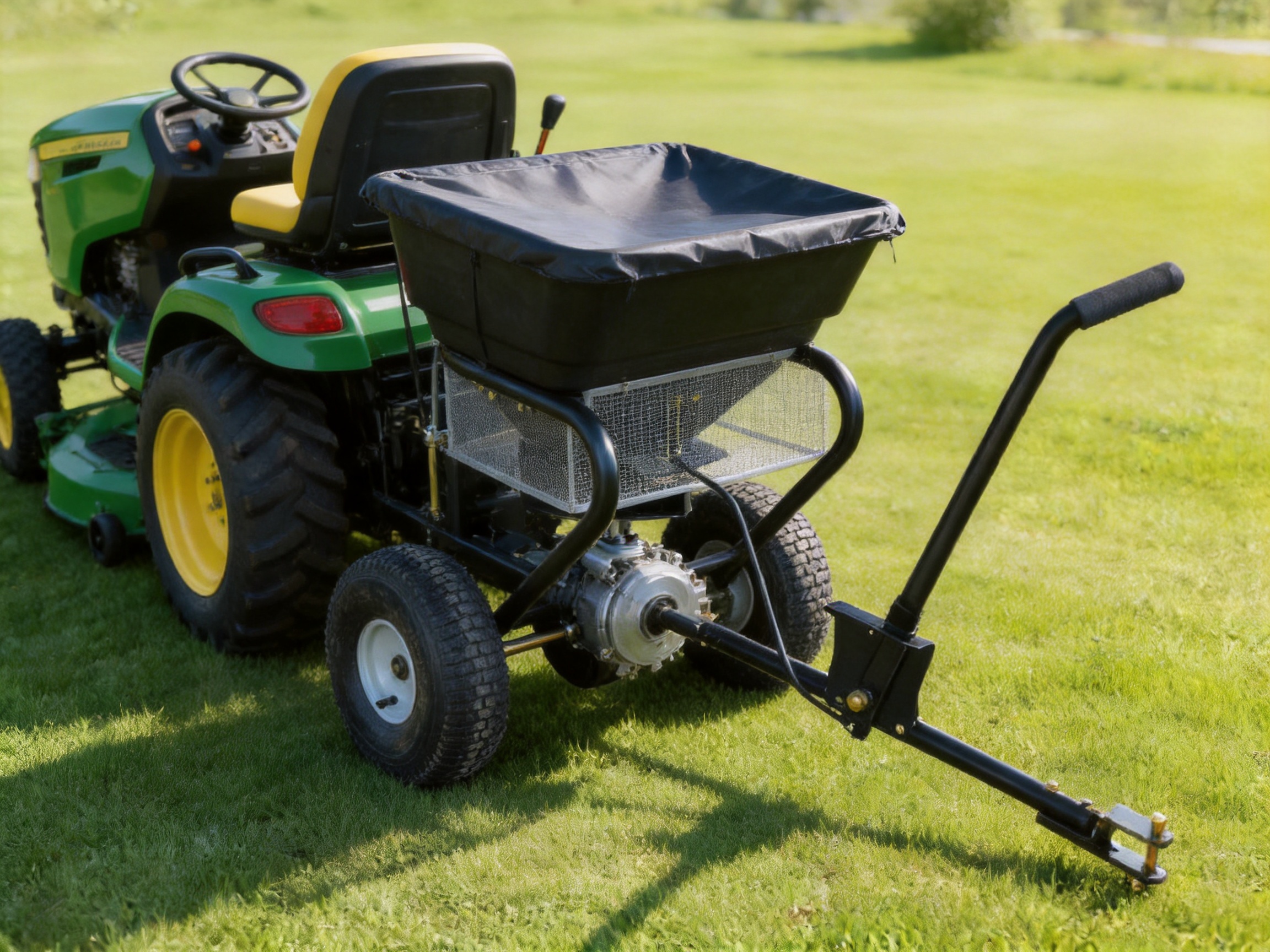
Screen and Rain Cover Accessories
The included screen and rain cover extend the practical function of the spreader. A screen can help filter oversized particles, clumps, debris, or pieces of material that could interfere with consistent flow. This is useful when handling granular products that may have been stored in less-than-ideal conditions.
By helping prevent large clumps from entering the spreading mechanism, the screen can support smoother operation. It may also reduce the chance that foreign objects will reach the gear or spinner area. The screen should remain clean and should be inspected regularly, because dust and damp material can accumulate around openings.
The rain cover helps protect the material in the hopper during changing weather. A sudden shower can cause fertilizer, seed, or ice melt to absorb moisture and form clumps. Keeping the hopper covered can reduce exposure while the spreader is parked temporarily or while the operator is working in light rain.
The cover is a convenience and protection accessory rather than a reason to leave material stored in the spreader for long periods. After use, the hopper should be emptied, cleaned, and dried. Long-term storage of fertilizer or ice melt inside the hopper can increase the risk of corrosion, blockages, and material hardening.
Applications Across the Year
Fertilizer Application
The SP31575 can be used to apply granular lawn fertilizer across residential lawns, institutional grounds, sports fields, roadside green areas, and commercial landscapes. Its tow-behind design allows the operator to cover larger areas with fewer refills than many small handheld spreaders.
Fertilizer should be applied according to the product manufacturer’s instructions. Overapplication can damage turf, waste material, and create unwanted runoff. A measured test pass is recommended before treating the entire area. Operators should also avoid spreading near watercourses, drainage channels, and sensitive planting areas unless the fertilizer label specifically permits such use.
Grass Seed and Overseeding
Grass seed can be distributed during lawn establishment, repair, overseeding, and renovation work. Consistent travel speed and suitable flow adjustment are important because seed is usually lightweight and may not spread in the same way as dense fertilizer granules.
For best results, the ground should be prepared before seeding. Soil contact, moisture, and follow-up watering influence germination. The spreader is responsible for distribution, but successful lawn establishment depends on the full preparation and maintenance program.
Ice Melt and Winter Maintenance
During winter, the SP31575 can be used for suitable ice-melting materials on driveways, private access roads, paths, yards, and other appropriate surfaces. The towing vehicle allows the operator to treat long routes while remaining seated and maintaining a controlled pace.
Ice melt should be applied at the recommended rate. Excessive use can increase environmental impact, damage vegetation, affect concrete or masonry, and create unnecessary operating costs. After winter use, the spreader should be thoroughly emptied and washed where appropriate, then dried and inspected for residue.
Other Granular Materials
The product description identifies fertilizer, seeds, ice melt, and more as potential applications. Any alternative material should be evaluated for particle size, moisture content, corrosiveness, flow behavior, and compatibility with the hopper and spreading mechanism. Powders, liquids, very wet materials, oversized pieces, and substances that may react with the equipment should not be used unless specifically approved.
Spread Width and Coverage Management
The listed spread width of approximately 10 to 12 feet gives the SP31575 a useful operating range for open spaces. A wider distribution pattern can reduce the number of passes required, improving productivity compared with narrow walk-behind equipment.
Actual coverage is affected by several variables. The material’s shape and density influence how it leaves the spinner. Travel speed affects the amount applied per unit of ground. Wind can move lightweight particles away from the intended path. Moisture can cause bridging, clumping, or irregular flow. The condition of the gear system and spinner also affects performance.
Operators should plan parallel passes and use consistent overlap. The correct overlap depends on the material and adjustment setting. A test area can reveal whether the pattern is centered, whether the edges are receiving enough material, and whether the application rate is appropriate.
Property boundaries require additional care. When spreading near gardens, ponds, sidewalks, roads, or neighboring properties, the operator should reduce the flow or use a suitable border strategy. The ability to adjust the flow lever from the seat makes these transitions more convenient.
Metal Gear System and Drive Reliability
The SP31575 uses metal gears to transfer wheel movement to the spreading mechanism. This is a meaningful design choice because the drive system operates whenever the spreader is moving. Repeated starts, stops, uneven surfaces, and loaded operation place demands on the gear train.
Metal drive components are generally valued for their strength and resistance to deformation under ordinary mechanical loads. Compared with basic plastic drive systems, a metal gear arrangement may offer a more robust solution for users who expect repeated seasonal operation. However, durability still depends on proper assembly, lubrication where required, correct loading, and protection from corrosion.
Operators should not tow the unit with a damaged wheel, bent axle, loose fastener, or obstructed spinner. The gear system should be inspected if unusual noise, slipping, grinding, or inconsistent spreading occurs. A clean drive area is important because packed fertilizer, wet seed, and ice melt residue can interfere with moving parts.
Using a metal gear does not mean that the spreader can be overloaded or driven aggressively over unsuitable terrain. The rated capacity should be respected, and the spreader should be towed at a controlled speed. Smooth operation reduces shock loads and supports longer service life.
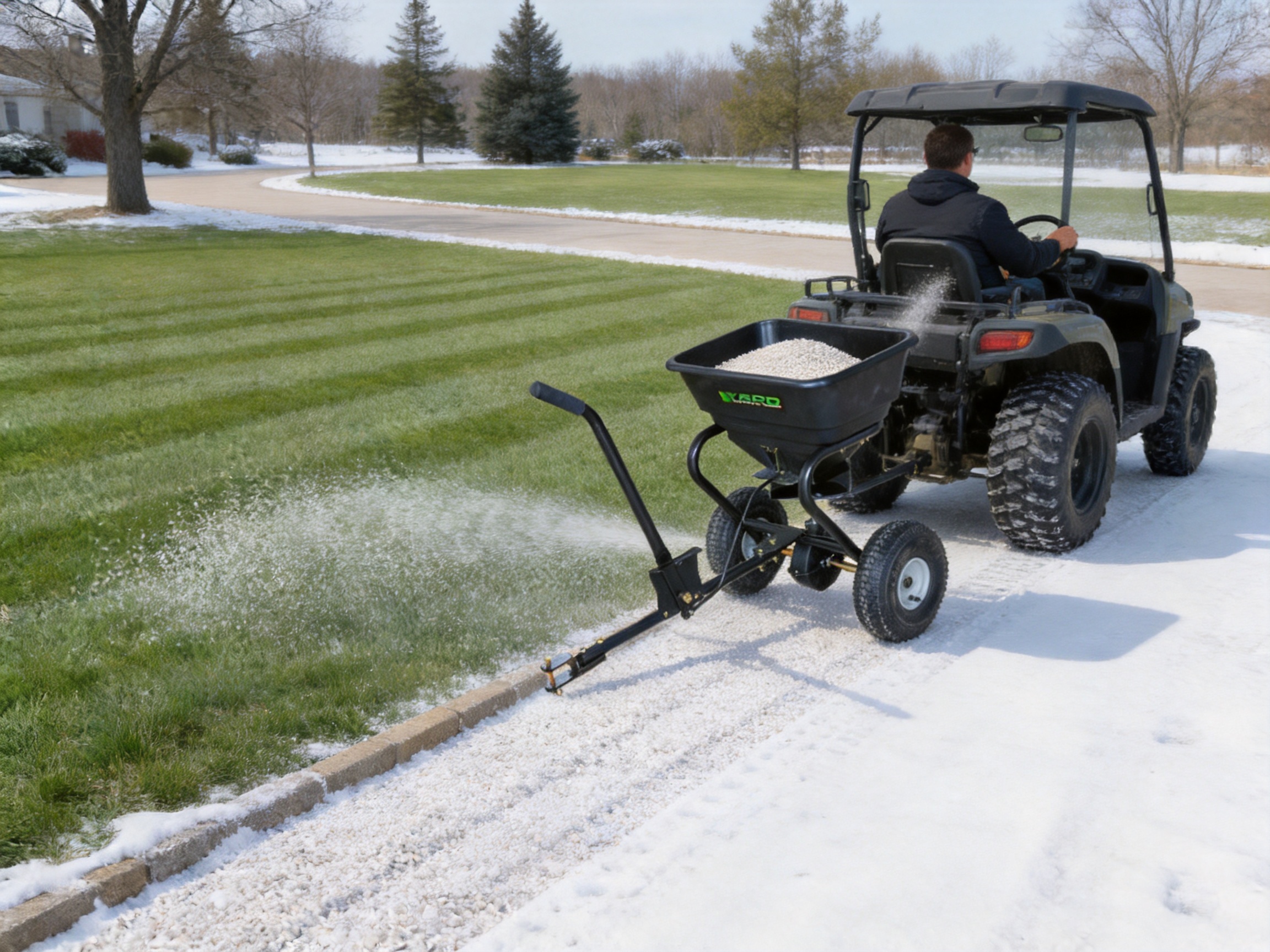
Pneumatic Tires for Outdoor Terrain
The 10-inch pneumatic tires provide cushioning and rolling support for the tow-behind design. Air-filled tires can adapt to minor changes in ground surface and help absorb vibration when traveling over grass, compacted earth, gravel, and other ordinary outdoor terrain.
Tire pressure should be checked before use. Underinflation can increase rolling resistance and make the spreader less stable, while overinflation can reduce cushioning and increase the risk of damage. The recommended pressure should be obtained from the product documentation or tire markings.
Tire condition also affects spreading consistency. If one tire is damaged, partially deflated, or rotating unevenly, the spreader may not track correctly behind the towing vehicle. Uneven tracking can affect the operator’s line and may place additional stress on the hitch, axle, and gear system.
When storing the spreader for an extended period, it should be protected from prolonged direct sunlight and standing water. The tires should be inspected before the next season, particularly if the unit has been stored in a damp area or exposed to temperature extremes.
Comparative Advantages Over Basic Spreader Designs
Product comparisons should be based on application requirements rather than on a single feature. The SP31575 offers several advantages over basic handheld, small push, or lightly constructed tow spreaders, particularly for users who need a combination of capacity, towing compatibility, seasonal flexibility, and operating convenience.
| Feature | SP31575 Benefit | Practical Value |
|---|---|---|
| 70 lb capacity | Holds a useful quantity of granular material | Fewer refills across larger areas |
| Tow-behind design | Connects to lawn and garden tractors and ATVs | Reduces operator fatigue and supports wider property maintenance |
| Seat-level flow control | Operator can manage material delivery while driving | Improves convenience at starts, stops, and boundaries |
| Metal gears | Provides a substantial mechanical drive arrangement | Suitable for repeated outdoor use with proper maintenance |
| Rust-resistant powder coat | Protects exposed surfaces from ordinary outdoor conditions | Supports durability and product appearance |
| Screen | Helps limit oversized particles and clumps | Supports more dependable material flow |
| Rain cover | Helps shield material during temporary exposure to weather | Reduces moisture-related clumping during operation |
| Pneumatic tires | Provides cushioned rolling over common outdoor surfaces | Improves maneuverability and towing comfort |
| Year-round use | Supports fertilizer, seed, ice melt, and other suitable materials | Improves equipment utilization across seasons |
A handheld spreader may be less expensive and easier to carry, but it requires the operator to support the material load and walk the entire route. A small push spreader may be suitable for compact lawns, but it can become tiring on large properties. A larger commercial spreader may provide greater capacity, yet it can also require more storage space, a larger towing vehicle, and a higher investment.
The SP31575 occupies a practical middle position. It provides a tow-behind operating method and a meaningful 70 lb capacity without being presented as an oversized commercial machine. This balance may appeal to homeowners with large properties, small landscaping contractors, grounds crews, farms, and organizations managing multiple sites.
Manufacturing Strengths and Quality Management
The product is manufactured by Jiashan Superpower Tools Co., Ltd., a Chinese producer specializing in log splitters and lawn and garden equipment. Its product range includes dump carts, spreaders, lawn sweepers, lawn aerators, and other outdoor power equipment. This category experience is relevant because a manufacturer working across related outdoor products develops knowledge of towing systems, frames, wheels, hoppers, coatings, mechanical drives, packaging, and seasonal equipment requirements.
The company was established in 1997 and has more than two decades of industry experience. Long-term operation in the outdoor equipment sector can support accumulated expertise in product development, production planning, quality control, supplier coordination, and export requirements. Experience alone does not replace product inspection, but it provides an important foundation for repeatable manufacturing.
The manufacturing facility is located in the Huimin Economic Development Zone in Jiashan County, Zhejiang Province, between Shanghai and Hangzhou. This location provides access to established industrial infrastructure, component suppliers, transportation networks, ports, and export logistics. Those factors can support efficient procurement, production scheduling, container loading, and international distribution.
The company operates under an ISO 9001:2015-certified quality management system. ISO 9001 is associated with documented quality processes, defined responsibilities, process monitoring, corrective action, and continual improvement. Certification does not guarantee that every individual product is free from defects, but it indicates that the organization maintains a formal framework for managing quality-related activities.
Many of the company’s products carry CE certification. For applicable products and markets, CE-related conformity work may involve assessment against relevant European Union requirements. Buyers should confirm the exact certification and documentation for the particular model and destination market rather than assuming that a certification for one product applies automatically to every product.
Advanced Manufacturing Process Considerations
A reliable spreader depends on the coordinated performance of multiple manufacturing stages. The frame and hopper must be formed accurately, the axle and wheels must align, the gear system must mesh correctly, the control mechanism must operate smoothly, and the coating must adhere to prepared surfaces. Quality is therefore a system outcome rather than the result of one isolated operation.
Material Preparation and Forming
Metal components should be selected and prepared according to their intended function. Load-bearing parts require appropriate strength and dimensional stability, while hopper components require a surface that can be cleaned and that supports material flow. Forming operations must maintain consistent dimensions so that the hopper, frame, axle, hitch, and accessories fit together correctly.
Welding and Frame Assembly
Welded assemblies require attention to joint preparation, alignment, weld consistency, and inspection. A properly aligned frame helps the spreader track behind the towing vehicle and reduces unnecessary stress on the axle and hitch. Weld quality also influences the unit’s ability to withstand vibration during transportation and operation.
Gear and Mechanical Assembly
The metal gear system must be assembled with suitable alignment and clearance. Improper gear engagement can produce noise, rapid wear, or inconsistent spinner movement. Assembly checks should include wheel rotation, drive engagement, fastener security, and freedom of movement in the flow-control linkage.
Surface Treatment and Powder Coating
Powder coating performance begins before the powder is applied. Cleaning, degreasing, surface preparation, and handling are important because contaminants can reduce adhesion. The coating must then be applied and cured according to controlled process conditions. Consistent finishing supports corrosion resistance and a more uniform appearance.
Final Inspection and Packaging
Final inspection can include visual checks, dimensional verification, wheel and hitch inspection, flow-control operation, accessory confirmation, and packaging review. The product’s package size is listed as 22.6 × 16.1 × 27 inches, with a net weight of 23.2 lb and gross weight of 28.22 lb. Careful packaging is important because outdoor equipment can be exposed to handling, stacking, vibration, and moisture during international transportation.
The listed container quantity of 408 pieces per 40-foot high-cube container indicates that the product has been considered for efficient bulk shipment. Container efficiency can reduce logistics complexity for importers and distributors, although actual loading results may depend on packaging configuration, palletization, local handling requirements, and container-loading procedures.
Installation and Operating Preparation
Before first use, the spreader should be assembled according to the supplied instructions. The hitch, wheels, axle, hopper, spinner, flow-control mechanism, screen, rain cover, and fasteners should be checked. The unit should be connected only to a towing vehicle with a compatible hitch and sufficient capacity for the loaded spreader.
The operator should verify that the hitch connection is secure and that the spreader can turn without contacting the towing vehicle. Safety pins, retaining clips, and other connection hardware should be properly installed. The control lever should be checked from the driver’s seat before material is loaded.
The spreader should be tested empty first. This permits the operator to confirm wheel rotation and spinner movement without the additional weight of material. A small quantity of the selected material can then be used for a controlled test pass. The result should be checked before beginning full-area application.
Material should be loaded evenly and should not exceed the rated capacity. Large clumps or foreign objects should be removed. If the rain cover is used, it should be secured so that it does not interfere with the flow-control lever or spreading mechanism.
Maintenance Recommendations
Regular maintenance supports performance and helps protect the investment. After each use, the hopper should be emptied. Remaining fertilizer, seed, or ice melt can absorb moisture, harden, attract contamination, or promote corrosion.
The hopper and spreading components should be cleaned using a method suitable for the material and the equipment. Water may be appropriate for certain residues, but the unit should be dried thoroughly afterward. Electrical components, if present on a particular configuration, should be protected from unnecessary water exposure.
The screen should be removed or opened for inspection where appropriate. Blocked openings can reduce material flow and create uneven distribution. The spinner should be checked for buildup, while the gear housing should be inspected for debris, damage, and signs of lubricant loss.
Fasteners should be checked periodically for tightness. Vibration can loosen hardware over time, particularly when the spreader is towed over rough ground. The tires should be checked for pressure, cuts, cracking, and abnormal wear. The hitch and axle should also be inspected before every major operating session.
If lubrication points are identified in the product manual, the recommended lubricant and service interval should be followed. Lubrication should not be added indiscriminately, because excess lubricant can attract dust or contaminate spreading material.
Safety and Responsible Use
The spreader should be operated only by a person familiar with the towing vehicle and the material being applied. Loose clothing, hands, and tools should be kept away from the spinner, gear, axle, and other moving parts while the equipment is operating.
The towing vehicle should travel at a moderate speed appropriate to the terrain. Sudden acceleration, sharp turns, steep slopes, and rough ground can increase the risk of instability or damage. The operator should allow additional stopping distance because the towing vehicle is pulling a loaded implement.
Fertilizer, seed treatment products, salt, and ice melt may require gloves, eye protection, respiratory protection, or other personal protective equipment. The label and safety data for the material should be reviewed before use. The spreader itself does not replace the handling requirements of the material manufacturer.
Children and bystanders should remain away from the operating area. The work zone should be checked for stones, branches, toys, tools, and other objects that could interfere with the wheels or spreading mechanism. The unit should be disconnected from the towing vehicle before maintenance, cleaning around moving parts, or clearing a blockage.
Why the Product Suits International Buyers
The SP31575 may be suitable for distributors and equipment dealers seeking a compact tow-behind spreader with broad seasonal applications. Its capacity, accessories, metal gear system, pneumatic tires, and corrosion-conscious finish create a specification profile that can be communicated clearly to retail and professional customers.
International buyers can also benefit from the manufacturer’s experience serving customers in North America, Europe, Australia, Asia, and South America. Exposure to multiple markets can support familiarity with differing packaging expectations, product documentation, importer requirements, and distribution models.
The company’s stated focus on innovative, energy-efficient, environmentally friendly, and cost-effective products aligns with the needs of buyers who want practical outdoor equipment rather than unnecessarily complex machinery. For a tow spreader, efficiency includes not only fuel or power use during towing but also reduced labor, fewer refills, good storage efficiency, and the ability to use one machine across several seasons.
Distributors should confirm model-specific documentation, available spare parts, warranty terms, packaging details, labeling, and compliance requirements before placing an order. They should also ensure that the spreader’s hitch design and material application instructions are suitable for the target market.
Frequently Asked Questions
What is the capacity of the SP31575?
The listed capacity is 70 lb or 26 L. The actual weight held may vary according to material density, particle size, and moisture content. The spreader should not be loaded beyond its stated capacity.
What vehicles can tow this spreader?
The product is designed to work with lawn and garden tractors and ATVs. The towing vehicle must have a compatible hitch and sufficient capacity to pull the loaded spreader safely over the intended terrain.
How wide is the spreading pattern?
The listed spread width is approximately 10 to 12 feet, or 3048 to 3658 mm. Actual width depends on the material, flow setting, travel speed, spinner condition, wind, and other operating factors.
Can the operator control the flow while driving?
Yes. The spreader includes a flow control lever that can be operated from the driver’s seat. This helps the operator manage material delivery without dismounting from the towing vehicle.
What materials can be used?
The product is intended for year-round use with fertilizer, seeds, ice melt, and other suitable granular materials. Any alternative material should be assessed for compatibility, moisture, particle size, corrosiveness, and flow characteristics.
Does the product include accessories?
Yes. The listed accessories include a screen and a rain cover. The screen can help limit clumps and oversized particles, while the rain cover helps protect material during temporary exposure to weather.
Why are pneumatic tires useful?
The 10-inch pneumatic tires provide cushioning and rolling support on common outdoor surfaces such as grass, compacted soil, and gravel. Correct tire pressure and regular inspection are important for safe and consistent operation.
What type of gear system does the spreader use?
The product information specifies a metal gear system. The gears transfer wheel movement to the spreading mechanism and should be kept clean, correctly aligned, and properly maintained.
Is the finish suitable for outdoor use?
The spreader has a rust-resistant powder coat finish intended to help protect exposed surfaces in outdoor conditions. Cleaning and drying remain necessary, especially after using fertilizer or salt-based ice melt.
How should the spreader be cleaned after winter use?
The hopper should be emptied, and residues should be removed from the hopper, frame, spinner, screen, and other exposed components. The unit should then be dried thoroughly and inspected for corrosion or damaged parts before storage.
Is the SP31575 suitable for commercial use?
It may be suitable for small landscaping businesses, property maintenance teams, farms, and grounds crews that need a compact tow-behind spreader. Commercial users should evaluate daily workload, terrain, maintenance practices, local safety requirements, and the availability of replacement parts.
How can users achieve more even coverage?
Users should select the correct flow setting, maintain a consistent travel speed, plan parallel passes, allow suitable overlap, and test the pattern over a small area before full application. Wind, damp material, clumps, and changes in speed can affect uniformity.
Conclusion
The 70 lb Tow Spreader SP31575 is a practical solution for users who want more capacity and less physical effort than a handheld or small push spreader can provide. Its tow-behind configuration works with lawn and garden tractors and ATVs, while the driver-operated flow control lever improves convenience during repeated passes and boundary transitions.
The product’s strongest advantages are its balanced specification: a 70 lb capacity, approximately 10 to 12-foot spread width, pneumatic tires, metal gears, rust-resistant powder coat finish, screen, and rain cover. Together, these features support fertilizer application, grass seeding, ice-melt distribution, and other suitable year-round tasks.
Its manufacturing background adds further value. The producer has operated in the outdoor equipment field since 1997, maintains an ISO 9001:2015-certified quality management system, and serves customers across multiple global markets. Product quality ultimately depends on proper manufacturing, inspection, assembly, packaging, and after-sales support, but the company’s established equipment specialization and formal quality framework provide a credible foundation.
For homeowners with large properties, landscaping professionals, grounds crews, farms, and distributors, the SP31575 offers a useful middle ground between small manual spreaders and larger commercial machines. When correctly matched to the towing vehicle, loaded within its rating, adjusted for the selected material, and maintained after each use, it can provide efficient and versatile outdoor material distribution across multiple seasons.
References
Product specification sheet for the 70 lb Tow Spreader SP31575, including capacity, spread width, tire, gear, packaging, and weight information.
Manufacturer company information for Jiashan Superpower Tools Co., Ltd., including company history, product categories, facility location, quality management, and international market service.
ISO 9001:2015, Quality Management Systems—Requirements.
General powder coating process guidance for industrial metal protection and outdoor equipment finishing.
General equipment safety and maintenance principles for tow-behind lawn and garden implements.
Product: 70lb. Tow Spreader SP31575
PREV:How a 22-Ton Vertical Log Splitter Supports Efficient Firewood Processing
NEXT:750 lb Trailer Cart SP22109: A Versatile Hauling Solution for Outdoor Work
NEXT:750 lb Trailer Cart SP22109: A Versatile Hauling Solution for Outdoor Work
Interested in cooperation or have questions?
Related products
-
-
◆MODEL NO.: SP31405 ◆STRONG SQUARE TUBE FRAME, 1"(25MM) HIGH CARBON ST...
See Details -
-
-
DESCRIPTION ♦Helps nutrients get into the soil and down to the ...
See Details -
DESCRIPTION ♦Helps nutrients get into the soil and down to the ...
See Details
