 LANGUAGE
 English
 Deutsch
 Español
 Français
 русский










Vertical operation position onlyHardened steel wedge24"/61cm split len...
See Details
22-Ton Half-Beam Gasoline Log Splitter: Performance, Versatility, and Manufacturing Strength
Preparing firewood can be physically demanding, especially when large, dense logs must be processed repeatedly during the cold season. A capable hydraulic log splitter reduces manual effort, improves work consistency, and helps operators complete demanding wood-processing tasks more efficiently. The Black Diamond 22-ton gasoline log splitter, model LSE22, is designed for users who need substantial splitting force, flexible operating positions, practical transportability, and dependable performance in residential, agricultural, landscaping, and light commercial applications.
The LSE22 combines a 6.5HP, 196cc gasoline engine with a two-stage hydraulic pump, a hardened steel wedge, a 4-inch hydraulic cylinder, and a 22-ton maximum splitting force. Its vertical and horizontal operating configuration provides additional flexibility when handling logs of different sizes and weights. Instead of requiring every log to be lifted onto a horizontal beam, the operator can place heavier logs directly on the ground and split them in the vertical position.
Its half-beam structure also contributes to a practical balance between strength, accessibility, and transport convenience. With a maximum log length of 25 inches, a 15-second cycle time, 16-inch DOT tires, and a high-speed axle, the machine is suited to users who want more than a basic consumer splitter without moving to a much larger professional unit.
Beyond the product itself, the manufacturer brings more than two decades of experience in log splitters and lawn and garden equipment. Jiashan Superpower Tools Co., Ltd. operates an ISO 9001:2015-certified quality management system and supplies outdoor power equipment to markets across North America, Europe, Australia, Asia, and South America. This combination of product-focused engineering, factory manufacturing, and international market experience supports the LSE22’s position as a practical and competitive wood-processing machine.
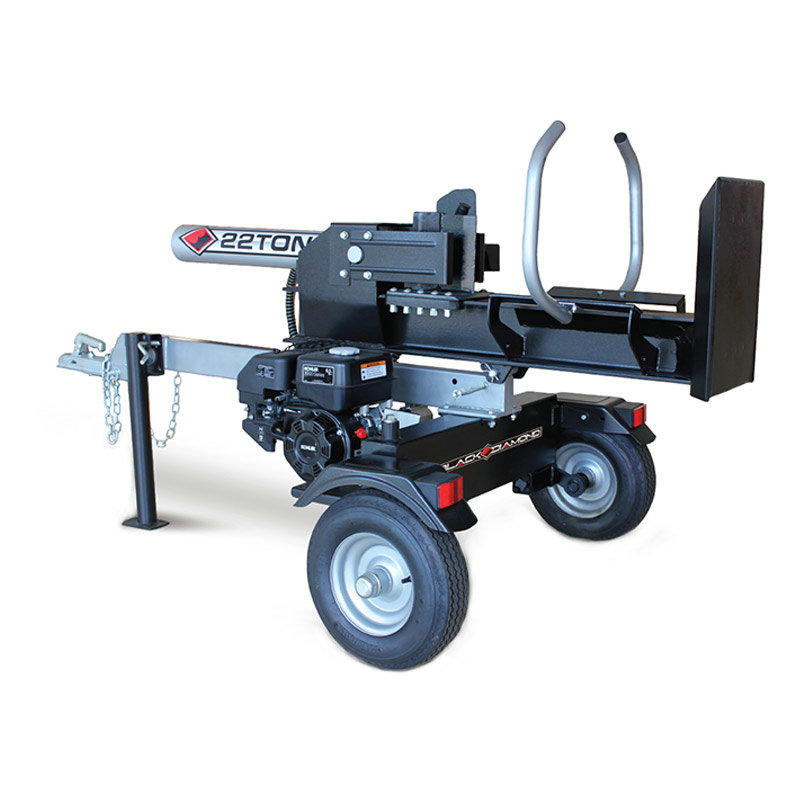
Black Diamond 22ton gasoline Log Splitter-half beam LSE22
Product Overview
The Black Diamond LSE22 is a gasoline-powered hydraulic log splitter intended for users who need reliable force without depending on an electrical connection. Its 22-ton maximum splitting force allows it to handle a broad range of firewood species and log conditions. While actual performance depends on wood hardness, grain structure, moisture content, knotting, temperature, and correct operation, the machine is engineered for demanding routine use.
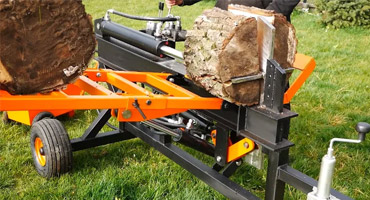
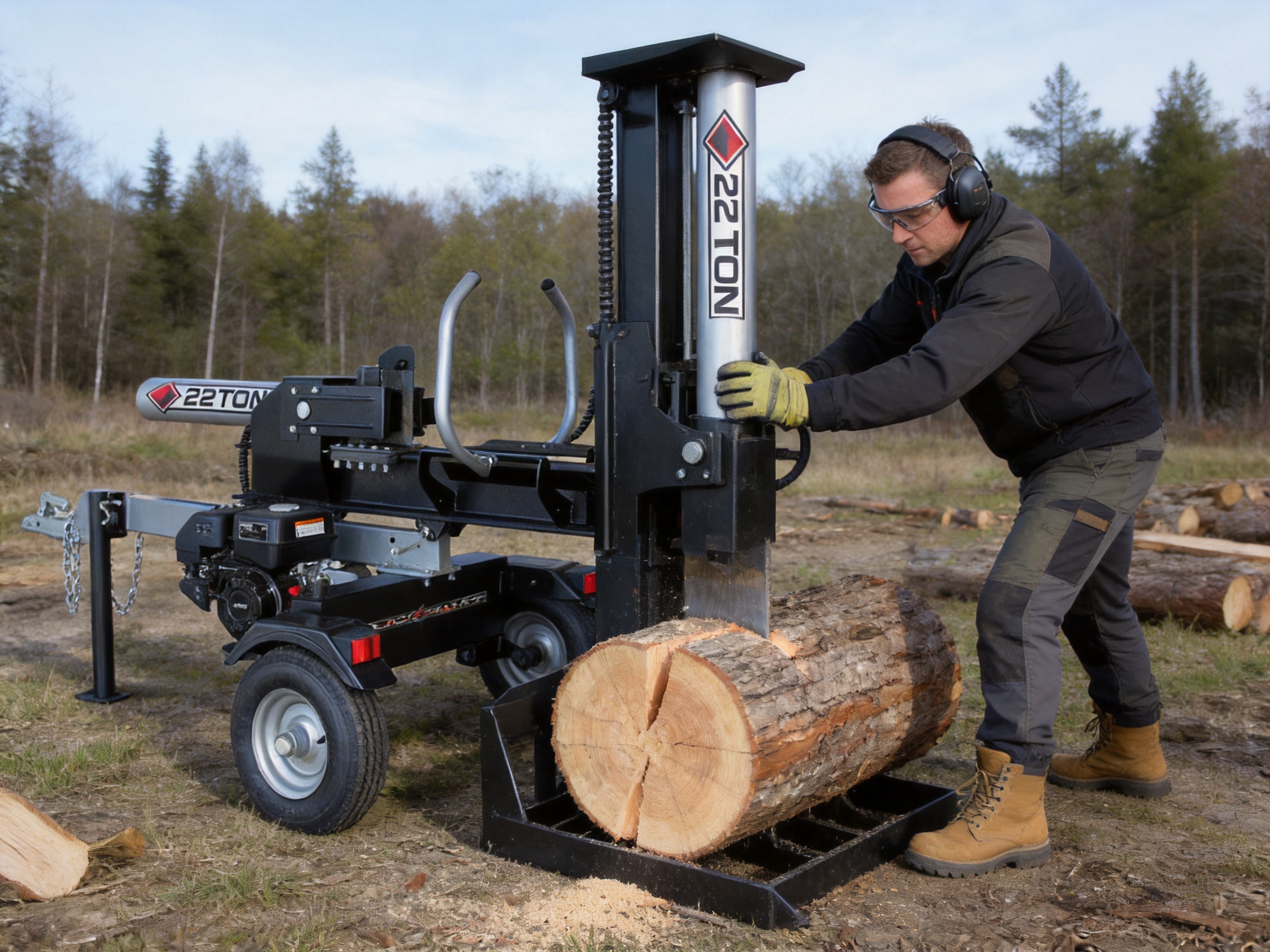
The splitter can be used in both horizontal and vertical positions. Horizontal operation is useful when processing smaller and moderately sized logs that can be lifted onto the beam. Vertical operation is especially valuable for large or heavy rounds. The operator can roll the log into position rather than lifting it to beam height, helping reduce strain and making the machine more accessible for longer work sessions.
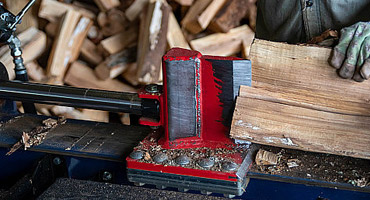
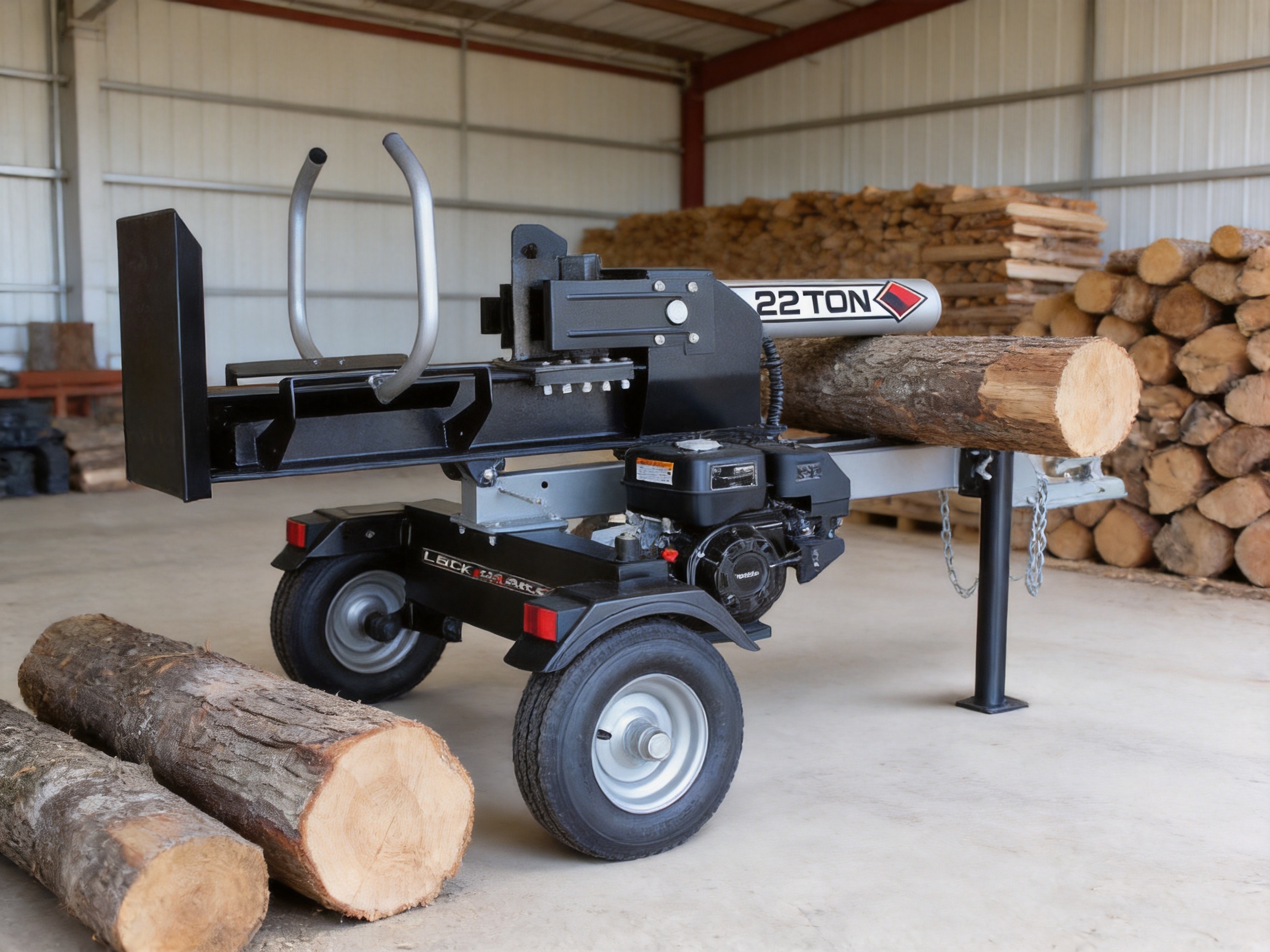
A cast-iron wedge provides a durable splitting interface. The wedge is specified as 8 inches and made from hardened steel, giving it the strength needed to penetrate wood repeatedly. The steel log cradle supports the log during splitting and helps stabilize its cutting position. This is an important safety and productivity feature because a stable log is easier to align and less likely to shift unpredictably during the hydraulic cycle.
The gasoline power unit gives the LSE22 operational independence. Users can work in wooded areas, rural properties, farms, and construction or landscaping locations where electrical power may be unavailable or inconvenient. The 6.5HP engine is matched with an 11GPM, two-stage hydraulic pump. This arrangement is intended to provide faster movement during low-load travel while delivering increased pressure when the wedge encounters resistance.
The 15-second cycle time supports steady work. Cycle time is only one part of overall productivity, since loading, repositioning, clearing, and stacking logs also affect output. However, a predictable return cycle helps operators establish a consistent workflow and reduces unnecessary waiting between pieces.
Key Specifications
| Specification | Details |
|---|---|
| Model | LSE22 |
| Maximum splitting force | 22 tons |
| Cycle time | 15 seconds |
| Engine | 6.5HP, 196cc gasoline engine |
| Maximum log length | 25 inches / 635 mm |
| Cylinder | 4 inches x 23-3/16 inches |
| Pump | 11GPM, two-stage hydraulic pump |
| Hydraulic capacity | 3.8 gallons / 14.5 liters |
| Wedge | 8-inch hardened steel wedge |
| Valve | Automatic return valve |
| Wheels | 16-inch DOT wheels, 4.8 x 8 |
| Net and gross weight | 495.6 and 551.3 pounds / 225 and 250 kilograms |
| Package dimensions | 70.9 x 23.2 x 32.7 inches / 180 x 59 x 83 centimeters |
| Container quantity | 60 pieces per 40-foot high-cube container |
22-Ton Splitting Force for Challenging Firewood
The main performance advantage of the LSE22 is its 22-ton maximum splitting force. In practical terms, this provides a substantial reserve of hydraulic power for logs that would be difficult to process with a small electric splitter or a low-force entry-level machine. Large rounds, dense hardwoods, twisted grain, and knotty sections can require significantly more force than straight-grained softwood.
A higher force rating does not mean that every log will split instantly or that operating technique is unimportant. Correct log placement, a sharp and undamaged wedge, appropriate hydraulic fluid, and a properly maintained engine all influence results. Nevertheless, a 22-ton platform gives the operator a wider working range than many lower-capacity machines.
Compared with compact splitters designed for occasional light-duty use, the LSE22 is better suited to users who process larger quantities of wood or encounter varying log conditions. Its capacity can reduce the need to cut large rounds into smaller pieces before splitting. This may save preparation time and create more uniform firewood production.
The machine is also suitable for mixed wood supplies. A homeowner may process softwood for seasonal heating, while a small farm or landscaping business may encounter hardwood limbs, storm-damaged trees, and irregular rounds. The combination of force and vertical operation makes the LSE22 adaptable to these changing conditions.
Horizontal and Vertical Operation
One of the most important design advantages is the ability to operate in both horizontal and vertical positions. A fixed horizontal splitter requires the user to lift each log onto the beam. That approach can be practical for small and medium-sized pieces, but it becomes tiring when logs are heavy or awkwardly shaped.
In vertical mode, the log can remain on the ground or on a low support surface while the operator positions it against the wedge. This reduces the lifting distance and can make heavy rounds easier to manage. It is particularly useful for users who process large-diameter logs, work alone, or need to minimize repetitive lifting.
Horizontal mode offers a different advantage. Smaller logs can be placed on the beam and moved through the splitting cycle in a continuous rhythm. The operator may find this position more efficient when preparing many lighter pieces. Switching between the two configurations allows the machine to accommodate changing log dimensions without requiring separate equipment.
This dual-position capability distinguishes the LSE22 from simpler machines that offer only one working orientation. It also provides a more flexible workflow than a splitter optimized exclusively for large rounds or exclusively for small firewood. The operator can choose the position that best matches the material and the task.
Operators should always follow the manufacturer’s instructions when changing positions. The splitter should be placed on stable, reasonably level ground, and the log should be centered and supported before the hydraulic control is activated. A versatile machine still requires disciplined setup and safe operating habits.
Half-Beam Design and Practical Accessibility
The half-beam configuration gives the LSE22 a compact and accessible working structure. It provides a clear splitting path while helping keep the overall machine manageable for transport, storage, and positioning. The design is suited to users who want serious splitting capacity without the size and complexity of a much heavier commercial processor.
A half-beam splitter can also make the wedge and log area easier to access for loading and clearing. Operators can maintain a closer visual connection with the work area and establish a straightforward sequence of placing, splitting, and removing logs. The integrated steel log cradle helps keep the workpiece aligned during this process.
Compared with very small portable splitters, the LSE22 offers greater structural and hydraulic capacity. Compared with larger full-frame commercial systems, it can be more approachable for farms, property owners, rental operations, and small businesses that do not need an industrial-scale production line. Its design therefore occupies a useful middle ground between light residential equipment and high-output commercial machinery.
Hydraulic System and Cycle Performance
The LSE22 uses an 11GPM two-stage pump and a 4-inch hydraulic cylinder measuring 23-3/16 inches. The cylinder supplies the linear movement required to drive the wedge through the log, while the two-stage pump supports a balance between movement speed and force delivery.
Two-stage hydraulic pumps are commonly used in log splitters because the hydraulic requirements change during a cycle. When the wedge is moving toward a log and resistance is low, the system can support faster travel. When the wedge contacts dense wood and pressure rises, the pump can shift toward a high-pressure operating stage. This design helps avoid making every part of the cycle unnecessarily slow.
The stated 15-second cycle time gives the operator a useful reference for expected movement between forward travel and return. Actual cycle duration can vary depending on engine speed, hydraulic oil temperature, ambient conditions, log resistance, and the precise operating sequence. Even so, the specification indicates that the LSE22 is designed for productive repeated use rather than occasional single-log operation.
The 3.8-gallon, or 14.5-liter, hydraulic capacity provides the fluid volume required by the system. Correct fluid level and suitable hydraulic oil are essential for maintaining pressure, reducing component wear, and avoiding overheating. Regular inspection of hoses, fittings, the reservoir, and the cylinder seal area should form part of normal maintenance.
The automatic-return valve contributes to workflow efficiency. After the splitting stroke, the ram returns without requiring the operator to hold the control continuously through the entire return movement. This can simplify repetitive work and help establish a consistent operating rhythm. The control should still be used carefully, and the operator should remain attentive throughout the cycle.
Engine Power and Off-Grid Flexibility
The 6.5HP, 196cc gasoline engine gives the splitter the independence expected from outdoor power equipment. Unlike a corded electric model, the LSE22 does not require a nearby electrical outlet or a long extension cable. This is a valuable advantage for rural properties, forest edges, farms, roadside cleanup locations, and other remote work areas.
Gasoline power also supports mobility between different work zones. Users can bring the splitter to the wood pile instead of transporting every log to a workshop or garage. This may be especially useful after tree removal, storm cleanup, or seasonal firewood harvesting, when logs are distributed across a property.
Gasoline equipment does require responsible fuel storage, ventilation, engine maintenance, and appropriate operation. The engine should be inspected according to the maintenance schedule, and fuel should be handled away from ignition sources. Users must also account for engine noise and exhaust, particularly when working near homes or enclosed structures.
For users who regularly process large quantities of wood outdoors, the absence of a power cable can improve convenience and reduce setup limitations. The LSE22 is therefore positioned as a flexible machine for locations where portability and independent operation are more important than quiet indoor use.
Wedge, Cradle, and Log Control
The 8-inch hardened steel wedge is a central working component. Its purpose is to concentrate hydraulic force into the log, initiating a split along the grain. A hardened steel construction is appropriate for repeated contact with dense wood and helps the wedge resist deformation during normal use.
Wedge condition should be checked periodically. Damage, excessive wear, or an altered edge can reduce splitting efficiency and may increase stress on the hydraulic system. Keeping the working area clear and ensuring that the wedge remains correctly mounted are also important parts of responsible operation.
The steel log cradle helps stabilize the log before and during the splitting stroke. Without adequate support, a round can rotate, slide, or move away from the wedge. The cradle helps create a more controlled cutting position, although it does not replace proper log placement. Logs should be positioned securely, and operators should never hold a log in place with their hands while the hydraulic control is engaged.
The cradle is particularly helpful when handling irregular pieces. Natural logs rarely have perfectly flat ends, and storm-damaged wood may have branches, bends, or uneven surfaces. A supporting structure gives the operator a better opportunity to align these pieces before applying force.
Transportability and Chassis Features
The LSE22 is equipped with 16-inch DOT tires measuring 4.8 x 8 and a high-speed axle. These features support movement around a property and contribute to practical transport between work areas. The tire and axle arrangement is more substantial than the small wheels found on some compact stationary splitters.
Transportability is important because log-processing work often occurs away from a permanent equipment shed. A machine that can be repositioned efficiently allows users to work near the log pile, reduce unnecessary handling, and organize a safer material flow. The ability to bring the splitter closer to the raw wood can reduce the distance that heavy logs must be moved manually.
The term DOT tire indicates a road-oriented tire specification, but users must observe all applicable local transportation regulations before towing the equipment on public roads. Requirements may vary by country, state, or municipality. Operators should confirm hitching, lighting, speed, braking, and registration requirements where relevant.
At approximately 495.6 pounds net and 551.3 pounds gross, the LSE22 is a substantial machine. Its weight contributes to stability during operation, but it also means that loading, unloading, hitching, and repositioning should be planned carefully. Appropriate towing equipment and safe handling procedures are essential.
Advantages for Different User Groups
Residential Firewood Users
Homeowners who heat with wood can benefit from the machine’s combination of force and operating flexibility. The 25-inch maximum log length accommodates substantial firewood pieces, while the vertical position reduces the need to lift heavy rounds. The 15-second cycle time can support seasonal preparation without requiring a full commercial processor.
For occasional users, the machine offers capacity beyond a small electric splitter. It can handle a wider variety of wood sizes and can be moved to the location where trees or logs are being processed. The owner should still consider storage space, fuel management, and annual maintenance before purchase.
Farms and Rural Properties
Farms and rural properties often have access to storm-damaged trees, fence-line clearing, orchard waste, and other sources of firewood. Because these materials may be irregular and distributed across a large area, a gasoline-powered machine with transport wheels can be advantageous.
The vertical/horizontal configuration is useful when the available logs vary considerably. Smaller branches and rounds can be processed horizontally, while large trunk sections can be handled vertically. This versatility may reduce the need for multiple machines or extensive manual resizing.
Landscaping and Tree-Service Operations
Small landscaping and tree-service businesses may need to process wood generated during pruning, removal, or cleanup work. A 22-ton splitter can convert some of this material into firewood or manageable pieces for disposal. Its transportable design supports movement between job sites, subject to legal towing and workplace requirements.
Businesses should evaluate expected daily volume, log diameter, staffing, transport regulations, and maintenance resources before selecting equipment. The LSE22 is suited to moderate processing requirements, but operations that require continuous industrial throughput may need a larger commercial system.
Equipment Dealers and Distributors
For dealers, the LSE22 offers a product profile that is easy to explain to customers: gasoline operation, 22-ton force, dual-position use, a 25-inch log capacity, and a practical wheel-and-axle system. Its package dimensions and container quantity are also relevant to import planning and inventory management.
The product can fit into an outdoor power equipment range alongside lawn sweepers, dump carts, spreaders, chippers, stump grinders, and other garden machinery. A diversified product line allows distributors to serve customers who need several types of property-maintenance equipment.
Manufacturing Experience and Factory Strengths
The manufacturer, Jiashan Superpower Tools Co., Ltd., specializes in log splitters and lawn and garden equipment. Its product scope includes dump carts, spreaders, lawn sweepers, lawn aerators, and other outdoor power equipment. This specialization gives the company practical familiarity with welded frames, hydraulic assemblies, wheel systems, engine-powered machinery, and outdoor-use requirements.
Established in 1997, the company has accumulated more than two decades of manufacturing experience. Long-term participation in the industry can support product refinement, supplier relationships, production planning, and familiarity with the requirements of overseas customers. Experience alone does not guarantee performance, but it provides a foundation for systematic improvement.
The company operates from the Huimin Economic Development Zone in Jiashan County, Zhejiang Province, between Shanghai and Hangzhou. This location provides access to established manufacturing networks, transportation infrastructure, component suppliers, and export channels. Such factors can support efficient production and international order fulfillment.
The manufacturer operates under an ISO 9001:2015-certified quality management system. A quality management system provides a structured framework for documenting processes, assigning responsibilities, managing corrective actions, and pursuing continuous improvement. For equipment buyers, this can be important because consistent manufacturing requires more than inspecting a finished machine; it also requires control throughout production.
Many of the company’s products carry CE certification. Certification requirements depend on the specific product, market, and applicable directives. Buyers should verify the documentation associated with the exact model and destination market. Nevertheless, experience with international compliance can help a manufacturer prepare products for customers in different regions.
Advanced Manufacturing Processes
A gasoline hydraulic log splitter requires coordination among multiple manufacturing disciplines. The frame must provide adequate structural support. The wedge must resist repeated impact and pressure. The hydraulic system must maintain fluid integrity. The engine, pump, valve, axle, tires, and controls must work together as one machine.
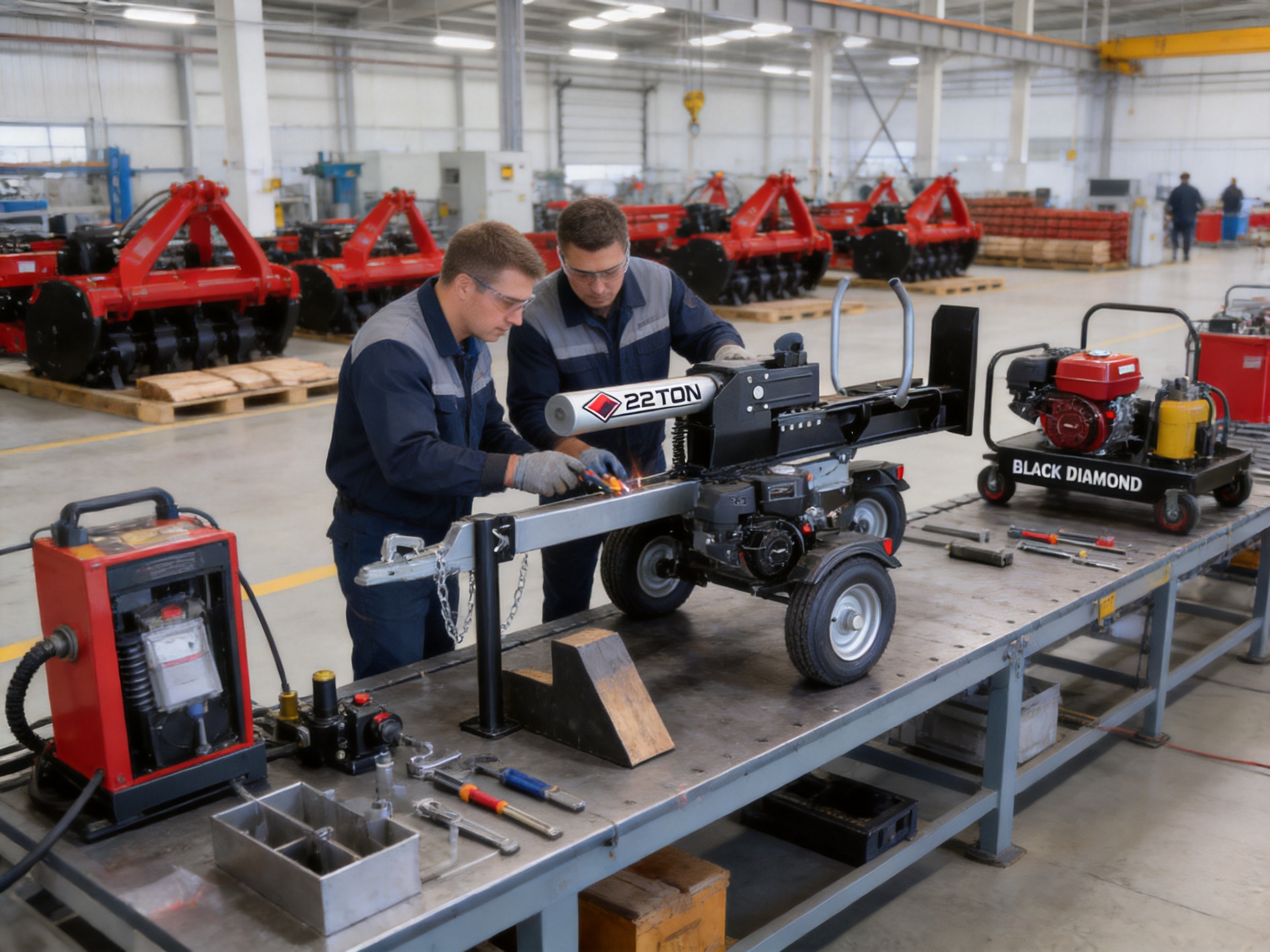
Production typically begins with material preparation and component sourcing. Steel sections are selected and cut according to engineering specifications. Accurate cutting helps ensure that frame components fit correctly during welding and assembly. Consistency at this stage contributes to alignment, dimensional control, and efficient downstream production.
Welding is central to the construction of the beam, cradle, supports, axle mounts, and other structural sections. Controlled welding procedures help produce strong joints and reduce distortion. Depending on the specific factory process, fixtures and jigs can be used to hold components in position while welds are applied. This improves repeatability across production batches.
After welding, structural assemblies may undergo grinding, cleaning, inspection, and surface preparation. Proper preparation supports coating adhesion and improves the appearance and durability of the finished product. Outdoor equipment must withstand contact with moisture, dirt, wood debris, hydraulic oil, and changing temperatures, so surface protection is an important part of product longevity.
Hydraulic assembly requires careful attention to seals, fittings, hoses, valves, and connection points. Clean assembly practices help reduce the risk of contamination entering the hydraulic circuit. Correct routing of hoses helps prevent abrasion, sharp bends, or interference with moving parts. Pressure and function checks can identify leaks or irregular operation before shipment.
Engine and pump installation require accurate alignment and secure fastening. The power transmission system must deliver engine output to the hydraulic pump without unnecessary vibration or misalignment. Fasteners should be tightened according to appropriate procedures, and moving components should be checked for clearance.
Final assembly includes installation of the wedge, log cradle, tires, controls, guards, decals, and other components. A finished unit should be examined for visible damage, missing hardware, incorrect connections, and functional problems. Testing may include engine starting, hydraulic cycling, ram return, valve operation, and inspection for leaks.
These manufacturing steps are valuable because they address the machine as an integrated system. A strong engine alone cannot compensate for poor hydraulic connections, and a high-force cylinder cannot deliver reliable performance if the frame or wedge is improperly aligned. Product quality depends on the relationship among all components.
Quality Control and International Supply
For an exported product, quality control must account for both the machine and the delivery process. Packaging dimensions, protective materials, labeling, manuals, and container loading all affect the customer’s experience. The stated package dimensions for the LSE22 are 70.9 x 23.2 x 32.7 inches, or 180 x 59 x 83 centimeters. The listed container quantity is 60 pieces per 40-foot high-cube container.
Efficient container planning can help distributors manage freight costs and inventory space. Consistent packaging dimensions also simplify warehouse organization and shipping calculations. However, actual loading arrangements should be confirmed with the supplier because packaging revisions, accessories, and destination requirements may influence final quantities.
International customers may require specific documentation, labels, spare parts, manuals, or compliance information. A manufacturer experienced in serving customers across North America, Europe, Australia, Asia, and South America is familiar with the importance of clear communication and market-specific expectations. Buyers should provide destination requirements early in the order process.
Factory-direct cooperation can also support product customization within reasonable engineering and production limits. Possible discussions may include branding, color, packaging, decals, accessory kits, manuals, and regional configuration. Any modification should be confirmed in writing and evaluated for its effect on safety, performance, certification, and lead time.
Operating Workflow for Efficient Results
A productive workflow begins with site preparation. The splitter should be placed on stable ground with sufficient clearance around the operator, log pile, and finished firewood. The work area should be free of loose branches, excessive mud, standing water, and obstacles that could interfere with movement.
Logs should be sorted before splitting when possible. Separating smaller pieces from large rounds allows the operator to choose horizontal or vertical operation more efficiently. Logs with visible cracks may split easily, while knotty, twisted, or unusually irregular pieces may require careful alignment and additional attention.
For horizontal operation, the log should be placed securely on the beam and against the cradle. The operator should keep hands, feet, clothing, and tools away from the wedge and moving ram. The control should be activated only after confirming that the log is stable and that no person is within the danger area.
For vertical operation, the machine should be set up according to the manufacturer’s instructions. Heavy logs should be rolled into position rather than lifted whenever possible. The operator should avoid standing directly in line with potential log movement and should ensure that the piece remains supported during the splitting stroke.
After each split, pieces should be removed from the working area so they do not obstruct the next log. A clear workflow reduces tripping hazards and helps maintain cycle efficiency. Finished pieces can be moved to a stacking area that is separate from the active splitting zone.
At the end of the session, the operator should inspect the machine for leaks, loose hardware, accumulated debris, and damage. The engine should be shut down according to the operating instructions, and the splitter should be stored in a dry, secure location.
Maintenance Considerations
Routine maintenance helps protect the investment and preserve performance. Engine maintenance generally includes checking oil, air filtration, spark-plug condition, fuel quality, and general cleanliness. Maintenance intervals should follow the engine supplier’s recommendations and should reflect the intensity of use.
The hydraulic system should be inspected for fluid level, leaks, damaged hoses, loose fittings, and unusual noises. Hydraulic oil should be changed or replenished using the correct specification and clean handling practices. A small leak can become a larger problem if it is ignored, while contaminated fluid can affect valves, seals, and pump performance.
The wedge and cradle should be checked for damage or deformation. Fasteners should be inspected for looseness, especially after the initial operating period and after transporting the machine over uneven ground. Tires should be examined for inflation, tread condition, sidewall damage, and secure mounting.
The frame and axle should be kept free from excessive dirt and corrosive material. If the machine is used in wet conditions, it should be cleaned and dried appropriately. Protective storage is particularly important during long periods of non-use, since exposure to moisture and temperature changes can affect metal surfaces, fuel components, and hydraulic parts.
Preventive maintenance is also a competitive advantage in practical terms. A machine with strong specifications can still lose productivity if it experiences avoidable downtime. Systematic inspections help users identify small issues before they interfere with peak-season firewood preparation.
Safety Features and Responsible Use
The LSE22 includes features that support controlled operation, including the steel log cradle, automatic-return valve, stable wheel system, and two operating positions. These features help create a more manageable workflow, but safe use still depends on operator training and attention.
Operators should read the instruction manual before use and understand the controls, emergency procedures, engine requirements, and hydraulic system. Appropriate personal protective equipment may include safety footwear, eye protection, hearing protection, gloves suitable for material handling, and close-fitting work clothing.
Hands should never be used to stabilize a log while the ram is moving. Operators should not attempt to clear a jam by placing any body part near the wedge or cylinder. The engine should be stopped before maintenance, adjustment, inspection, or removal of debris. Hydraulic pressure must be relieved according to the proper procedure before working on hydraulic components.
Children and untrained bystanders should remain away from the operating area. The machine should not be used in poor visibility, unstable terrain, or conditions that make it difficult to maintain control. Gasoline should be stored and handled safely, and the engine should not be operated in an enclosed area where exhaust gases can accumulate.
Comparison with Alternative Splitter Types
Electric log splitters are often appreciated for lower operating noise and convenient starting, but they depend on a suitable power supply. Their portability may also be limited by cables and outlet locations. The gasoline-powered LSE22 offers greater independence for outdoor and remote work.
Small compact splitters may be easier to store and move manually, but they generally provide less splitting force and may not accommodate large logs. The LSE22 is heavier, yet its higher capacity, vertical operation, and wheeled chassis make it more appropriate for substantial firewood preparation.
Large commercial wood processors can provide higher throughput and additional automation, but they also involve greater purchase cost, space requirements, maintenance complexity, and transport demands. The LSE22 can be a practical alternative for users whose work volume is significant but does not justify an industrial processing line.
Compared with single-position splitters, the LSE22’s horizontal and vertical capability offers more flexibility. Compared with lower-force machines, its 22-ton rating provides a wider operating range. Compared with machines without a supporting cradle, its steel log cradle offers a more controlled placement area. These advantages make it competitive for buyers seeking a balanced combination of power, versatility, and practical operation.
Purchasing and Distribution Considerations
Before purchasing, users should assess the typical diameter, length, hardness, and quantity of logs they process. The maximum stated log length is 25 inches, so buyers should confirm that this accommodates their normal material. They should also consider whether the machine will be stored indoors or outdoors, how it will be transported, and whether gasoline operation suits their work environment.
Dealers should evaluate product positioning, target customers, packaging, spare-parts availability, warranty arrangements, and service support. A clear technical data sheet can help sales staff explain the differences between the LSE22 and smaller or larger models.
For bulk orders, the listed 60-piece quantity per 40-foot high-cube container provides an initial planning reference. Shipping arrangements should also account for port requirements, customs documentation, destination labeling, insurance, and unloading equipment. The gross package weight should be considered when arranging warehouse handling.
Long-term cooperation with a factory can provide advantages beyond the first order. Regular communication may support forecasting, production scheduling, technical feedback, packaging improvements, and market-specific product development. The manufacturer’s stated focus on equality and mutual benefit aligns with this type of continuing business relationship.
Frequently Asked Questions
What is the maximum splitting force of the LSE22?
The LSE22 has a maximum splitting force of 22 tons. This capacity is intended to support demanding firewood processing involving a range of log species and sizes, subject to correct operation and normal equipment limitations.
What is the largest log length it can handle?
The maximum log length is 25 inches, or 635 millimeters. Users should also consider log diameter, weight, grain structure, and the condition of the wood when evaluating suitability.
Can the splitter operate vertically and horizontally?
Yes. The LSE22 is designed for both vertical and horizontal operation. Horizontal mode is useful for smaller and medium-sized logs, while vertical mode helps reduce lifting when processing heavy rounds.
What type of engine powers the machine?
The machine uses a 6.5HP, 196cc gasoline engine. Gasoline power allows operation in outdoor locations where electrical power may not be available.
How fast is the hydraulic cycle?
The stated cycle time is 15 seconds. Actual cycle performance can vary according to engine speed, hydraulic oil temperature, log resistance, and operating conditions.
What hydraulic pump does it use?
The LSE22 uses an 11GPM, two-stage hydraulic pump. The two-stage design is intended to support faster travel when resistance is low and increased pressure when the wedge encounters harder wood.
How large is the hydraulic reservoir?
The hydraulic capacity is 3.8 gallons, or 14.5 liters. Correct fluid level, suitable hydraulic oil, and clean maintenance practices are important for reliable operation.
What kind of wedge is included?
The machine is equipped with an 8-inch hardened steel wedge. The wedge concentrates hydraulic force into the log and should be inspected regularly for damage or excessive wear.
Does it have an automatic return function?
Yes. The LSE22 includes an automatic-return valve, which helps return the ram after the splitting stroke and supports a consistent operating rhythm.
Is it easy to transport?
The splitter has 16-inch DOT wheels measuring 4.8 x 8 and a high-speed axle. These features support movement between work areas, although the machine weighs approximately 495.6 pounds net, so proper towing and handling equipment are necessary.
Who is the machine best suited for?
It is suitable for homeowners with substantial firewood needs, farms, rural properties, landscaping operations, tree-service businesses, rental fleets, and outdoor power equipment distributors. Users with continuous industrial-scale production requirements may need a larger commercial system.
Where is the product manufactured?
The product is manufactured by Jiashan Superpower Tools Co., Ltd. in Zhejiang Province, China. The company specializes in log splitters and lawn and garden equipment and has operated since 1997.
Does the manufacturer have quality-management certification?
The company operates under an ISO 9001:2015-certified quality management system. Buyers should request the relevant documentation for their specific order and destination market.
Are customized orders possible?
Customization should be discussed directly with the manufacturer. Potential topics may include branding, color, packaging, decals, documentation, and regional requirements. Any proposed modification should be confirmed for technical, safety, compliance, and production implications.
Conclusion
The Black Diamond 22-ton gasoline log splitter, model LSE22, is designed around the needs of users who require meaningful hydraulic power, flexible positioning, and practical outdoor mobility. Its 22-ton force, 6.5HP gasoline engine, 11GPM two-stage pump, 15-second cycle time, 25-inch log capacity, hardened steel wedge, automatic-return valve, and steel log cradle create a balanced package for demanding firewood preparation.
The ability to work horizontally or vertically is one of its strongest practical advantages. It allows operators to process smaller pieces efficiently while also reducing lifting requirements for heavy rounds. The 16-inch DOT wheels and high-speed axle further support movement between work areas, while the half-beam configuration offers a useful balance between accessibility, capacity, and manageable equipment size.
Its competitive position is strengthened by the manufacturer’s experience in outdoor power equipment, international supply capability, ISO 9001:2015-certified quality management system, and focus on energy-efficient, environmentally responsible, and cost-effective product development. Manufacturing control across structural fabrication, hydraulic assembly, engine installation, testing, packaging, and export preparation helps support consistent product delivery.
For homeowners, rural property owners, farms, landscaping businesses, and equipment distributors, the LSE22 provides a capable middle-ground solution: more powerful and versatile than many light-duty splitters, while less complex and more accessible than industrial-scale wood-processing equipment. With proper setup, safe operation, and regular maintenance, it can become a valuable part of a dependable firewood-processing workflow.
References
1. Product technical specification sheet for the LSE22 22-ton gasoline log splitter.
2. Manufacturer-provided product description for the horizontal and vertical half-beam log splitter.
3. Manufacturer information concerning company history, product categories, international markets, and factory location.
4. ISO 9001:2015 quality management system principles and process-control practices.
5. General hydraulic equipment maintenance and safe-operation guidelines.
6. General outdoor power equipment fuel-handling, transport, and workplace-safety practices.
Product: Black Diamond 22ton gasoline Log Splitter-half beam LSE22
PREV:No previous article
NEXT:42-Inch Deluxe Tow-Behind Lawn Sweeper: Efficient Lawn Cleanup for Large Outdoor Areas
NEXT:42-Inch Deluxe Tow-Behind Lawn Sweeper: Efficient Lawn Cleanup for Large Outdoor Areas
Interested in cooperation or have questions?
Related products
-
-
DESCRIPTION Working at horizontal position onlyAuto return hydraulic c...
See Details -
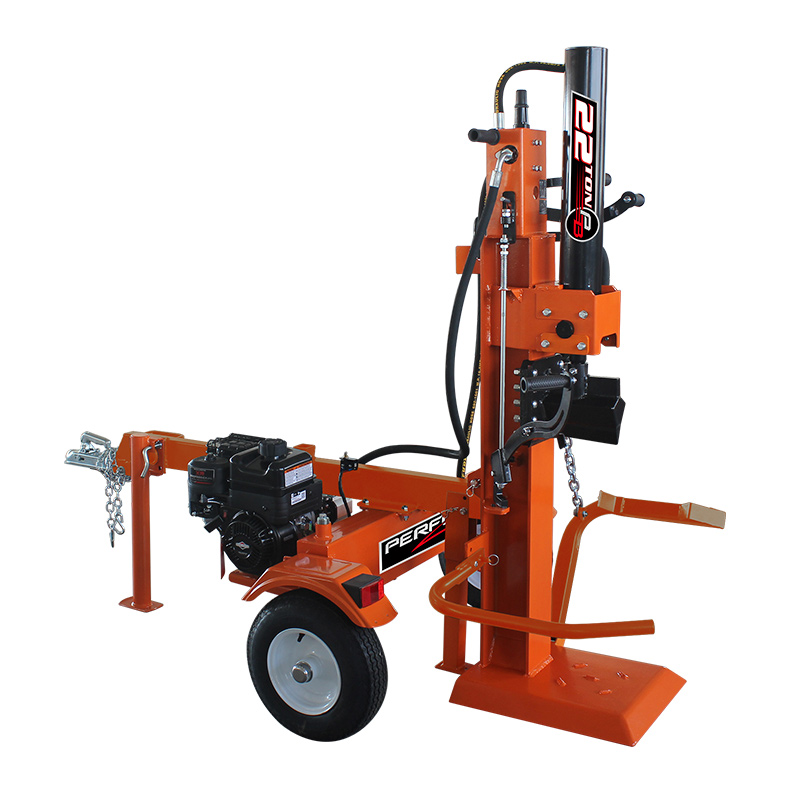
DESCRIPTION22Ton vertical/horizontal operating position allows foruse ...
See Details -
DESCRIPTION 22 Ton vertical/horizontal operating position allows forus...
See Details